Quick answer: Lebanese restaurant herbs in Dubai centre on flat-leaf parsley for tabbouleh, fresh mint for tabbouleh, fattoush and drinks, and jarjeer (rocket) for grills and salads, with radish and spring onion close behind. Buy them same-morning cut and dry. Nazwa Farm grows all three in Sharjah.
Few cuisines use fresh herbs in the volumes Lebanese kitchens do. For anyone sourcing Lebanese restaurant herbs Dubai menus depend on, herbs are not a garnish line but a main ingredient: tabbouleh is mostly parsley, and fattoush and mezze plates rely on bright, crisp greens. This guide covers what each dish needs, how to judge quality and how to plan bulk orders.
Which Herbs Do Lebanese Restaurants Use Most?
| Herb or green | Main dishes | What matters most |
|---|---|---|
| Flat-leaf parsley (bagdunis) | Tabbouleh, fattoush, kibbeh, garnish | Dry, deep green leaves; volume |
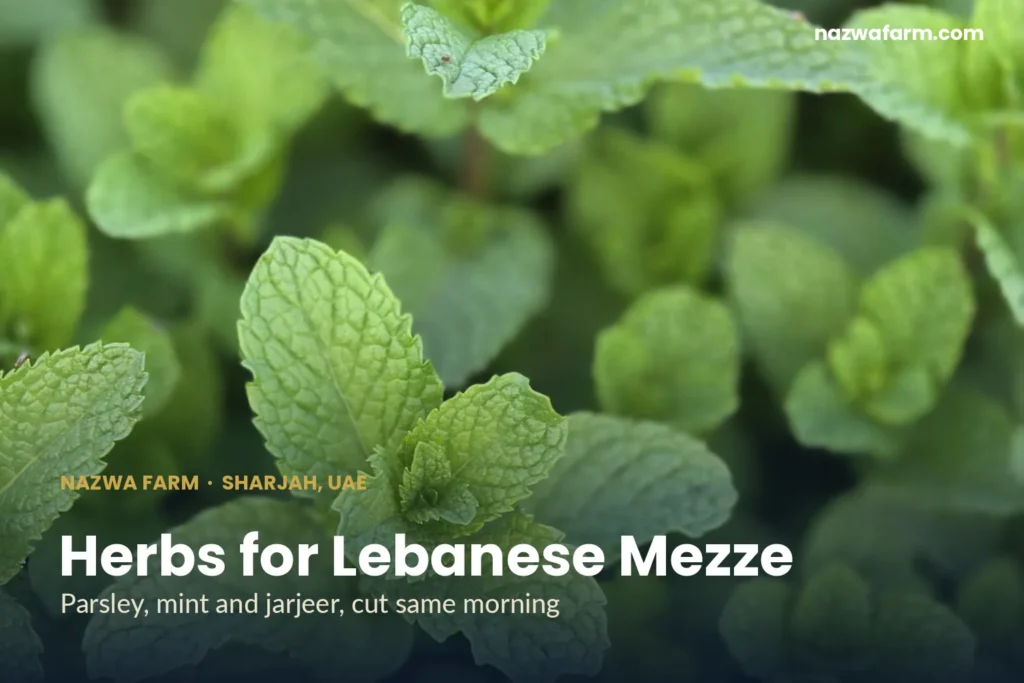
| Fresh mint (nana) | Tabbouleh, fattoush, laban drinks, mint lemonade, tea | Strong aroma; no black leaves |
| Jarjeer (rocket) | Side plate with grills, salads, fattoush variations | Crisp, peppery leaves; no yellowing |
| Radish | Fattoush, mezze crudités | Firm, crunchy roots |
| Spring onion | Tabbouleh, fattoush, salads | Firm bulbs, upright tops |
| Coriander | Batata harra, some dips and sauces | Fresh aroma; fast rotation |
On the Jumeirah Beach Road and Umm Suqeim strip, Lebanese and Mediterranean restaurants often share the street with cafés and juice bars, so mint and parsley demand runs high across the whole area.
What Do Tabbouleh Herbs in Bulk Need to Look Like?
Tabbouleh shows every weakness in the parsley. Look for:
- Deep green, flat leaves with no yellowing. Yellow leaves taste bitter and look poor in a finely chopped salad.
- Dry leaves. Wet parsley bruises under the knife and makes tabbouleh soggy.
- Firm stems. Limp stems mean the bunch has lost water.
- Clean bunches. Less grit means less washing, and less washing means drier parsley.
For mint, the test is aroma: crush a leaf and it should smell clean and strong. Mint stored too cold or too wet turns black at the edges, which spoils both the look of tabbouleh and the colour of mint lemonade.
Storage follows from this. Keep parsley cold and dry, wrapped in a lightly damp cloth in a covered container. Keep mint on a less cold shelf, away from the fan, or with stems standing in a little water. Keep jarjeer in its own box so heavier bunches do not crush the leaves. Each of the three behaves differently, so do not store them in one tub.

Lebanese Restaurant Herbs Dubai Kitchens Use: How to Prep Without Waste
- Wash, then dry thoroughly. Wash parsley and mint in cold water, then spin or spread to dry before chopping.
- Chop by hand. A sharp knife keeps tabbouleh parsley separate and green; processors mash it.
- Chop in batches. Chopped parsley holds for a service, not a day. Prep for lunch and again for dinner.
- Dress to order. Add lemon and oil to tabbouleh and fattoush only when plating.
- Keep jarjeer whole. Serve rocket as whole leaves and wash it just before service.
- Use the stems. Parsley and mint stems can flavour stocks, marinades and staff meals.
Our guide on reducing herb waste in restaurant kitchens goes further on storage, rotation and portion control.
What Should Be on a Fattoush and Mezze Herbs Order Checklist?
Before you message any fattoush ingredients supplier, work through this list:
- Portions per day of tabbouleh, fattoush and mezze plates, split by weekday and weekend.
- Weight of each herb per portion, measured once and written on the prep sheet.
- Drinks and desserts that use mint, such as mint lemonade and tea.
- Garnish and staff meals, which often add more than chefs expect.
- Delivery rhythm. Daily or near-daily orders keep parsley and mint fresher than one weekly drop.
Kitchens with very large, predictable volumes face similar planning questions. Our article on supplying campus canteens in Sharjah shows how high-volume kitchens plan greens around fixed menus.
Where to Get Mezze Herbs in Dubai’s Jumeirah Area
Nazwa Farm is a family farm in Nazwa, Sharjah, founded in 1999 by Md Mafzal Ahmed. We grow 22+ varieties of herbs and leafy vegetables in soil, harvest them the same morning, and sell farm-direct with no middleman or distributor markup. We have supplied traders at the Al Aweer market for about 25 years.
Lebanese and Mediterranean restaurants can see our fresh herb supply for Jumeirah and Umm Suqeim for everything we bring to the area, from parsley and mint to fresh zaatar and basil.
To order, send your list, quantity and area on WhatsApp at +971 50 936 9091 or email admin@nazwafarm.com, and we confirm the schedule the same day. Herbs are sold in bundles, packed in boxes of about 60 bundles. For prices, message us for today’s farm-direct price.
Frequently Asked Questions
Which herbs are used in Lebanese tabbouleh?
Tabbouleh is mainly flat-leaf parsley, very finely chopped, with a smaller amount of fresh mint, plus tomato, spring onion or onion, fine bulgur, lemon juice and olive oil. Parsley is the base of the dish, not a garnish, which is why Lebanese kitchens buy it in larger quantities than any other herb.
Should parsley for tabbouleh be chopped by hand or in a processor?
Most Lebanese chefs chop tabbouleh parsley by hand with a sharp knife. A processor tends to bruise and mash the leaves, releasing water and turning the salad dark and soggy. Hand-chopping dry parsley keeps the pieces separate, bright green and fresh-tasting, even if it takes more prep time.
What greens go into fattoush?
Fattoush usually combines lettuce, tomato, cucumber, radish, spring onion, parsley and mint, with toasted or fried pita and a dressing of lemon, olive oil and sumac, often with pomegranate molasses. Many versions add purslane, and some restaurants add rocket for a peppery note. Recipes vary from kitchen to kitchen.
How much parsley does a Lebanese restaurant need?
It depends on how many tabbouleh, fattoush and mezze portions you sell, and how much parsley each portion uses. Weigh the parsley in one portion of each dish, multiply by your daily covers, and add a margin for garnish and staff meals. Review the figure weekly against actual use.
Do you supply herbs to Lebanese restaurants in Jumeirah?
Yes. Nazwa Farm supplies Lebanese and Mediterranean restaurants, cafés and juice bars across Dubai, including Jumeirah and Umm Suqeim, on a daily wholesale basis. Send your list, quantity and area on WhatsApp at +971 50 936 9091 or email admin@nazwafarm.com, and we confirm the schedule the same day.
Key Takeaways
- Parsley, mint and jarjeer are the core herbs for Lebanese menus, with radish and spring onion close behind.
- Tabbouleh needs dry, deep green parsley, chopped by hand in batches.
- Dress salads to order and use stems in stocks and staff meals.
- Plan orders from portions per day and herb weight per portion.
- Nazwa Farm harvests the same morning and supplies Jumeirah restaurants farm-direct.
Running a Lebanese kitchen in Jumeirah? Send us your herb list today. Order on WhatsApp: +971 50 936 9091