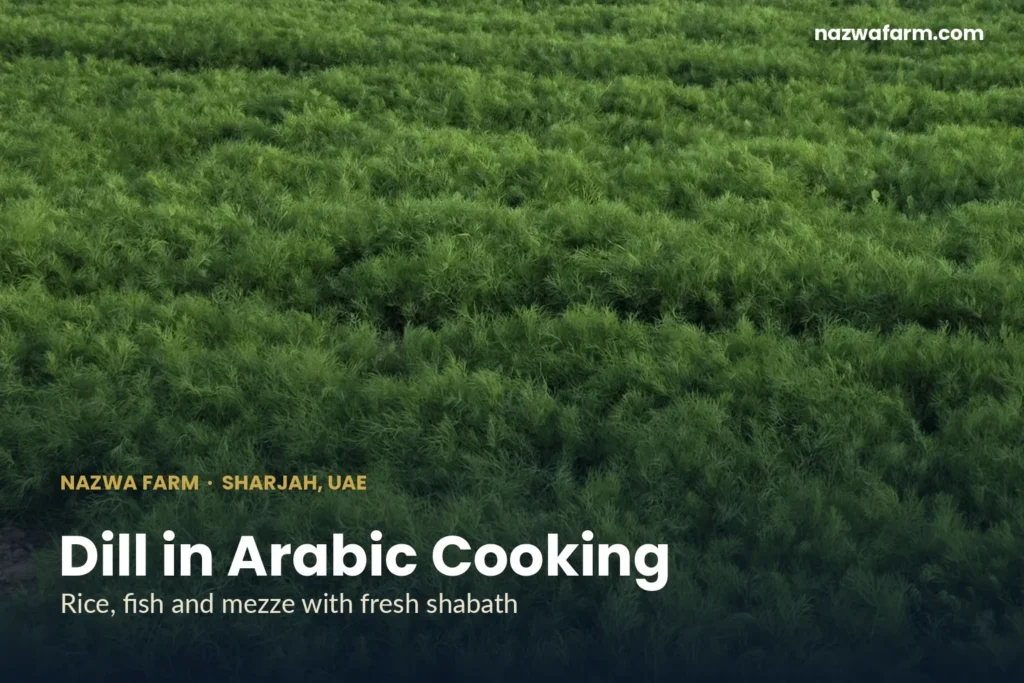
Quick answer: Dill in Arabic cooking appears most in rice with broad beans, stuffed vegetables, fish dishes and yoghurt dips. Use it fresh and add it late, because heat dulls its aroma. Restaurants in Al Majaz and Al Khan can order dill harvested the same morning from Nazwa Farm in Sharjah on WhatsApp.
Dill in Arabic cooking: where does it appear?
Dill, known in Arabic as shabath (شبت), is not as central as parsley or mint, but it plays a distinctive role in several regional cuisines. Its sweet, slightly aniseed aroma is the reason it is used with rice, fish and yoghurt rather than with heavy grilled meats.
The main traditions to know:
- Iraqi and Gulf homes: rice cooked with broad beans and plenty of chopped dill, often served with lamb or chicken.
- Persian kitchens, popular across the UAE: baghali polo, a closely related dill and broad bean rice.
- Egyptian cooking: dill often goes into the herb mix for mahshi, the rice filling for stuffed vegetables and vine leaves.
- Turkish menus: dill in cheese börek, yoghurt dips and olive oil vegetable dishes.
- Coastal cooking: dill with grilled or baked fish, often with lemon, garlic and olive oil.
For Sharjah’s waterfront dining strip, where Lebanese, Turkish and grill restaurants sit side by side, that makes fresh dill a quiet but steady line on the order sheet.
How do chefs use dill in rice dishes?
Dill rice, sometimes called shabath rice on Gulf menus, is where many kitchens use the most dill. A few practical points make the difference between a fragrant dish and a flat one:
- Use more than you think. Dill rice needs a generous quantity of chopped fronds. Dried dill gives a duller, hay-like note and cannot replace fresh in this dish.
- Add in two stages. Mix part of the dill into the rice before steaming, and fold the rest in at the end for aroma.
- Chop the fine stems too. Tender stems carry flavour. Only the thick lower stalks need to be discarded.
- Dry it before chopping. Wet dill clumps and turns mushy under the knife.
Kitchens that cook rice in big batches for lunch service should prep dill just before cooking rather than the night before.
How is dill used with fish in Arabic restaurants?
Fish restaurants along the Buhairah Corniche and in Al Khan often pair dill with local catches such as hammour and sea bream. Common uses include:
| Use | How dill is added | Kitchen tip |
|---|---|---|
| Grilled whole fish | Stuffed into the cavity with lemon and garlic | Use whole sprigs; they are easier to remove after grilling |
| Baked fish fillets | Scattered over with olive oil and tomato | Add half before baking and half fresh on top |
| Fish with rice | Folded into the rice served alongside | Keep the dill rice separate from spiced sayadieh-style rice |
| Yoghurt and labneh dips | Finely chopped and stirred in raw | Make small batches; dill darkens in dips after a day or two |
Hotel kitchens use dill in a similar way for seafood and breakfast buffets. Our guide for hotel herb supply in Dubai Marina covers how larger kitchens handle it across outlets.
How do you buy and store fresh dill for a restaurant?
Dill is one of the most delicate herbs a kitchen buys. Its fine fronds lose water quickly, so storage matters as much as sourcing.
- Look for: bright green, feathery fronds; a clean, sweet smell; firm stems.
- Avoid: yellow or brown tips, slimy patches in the centre of the bundle, a dull or sour smell.
- Store: chilled, loosely covered, and dry. Some chefs stand bundles upright in a little water in the chiller.
- Prep: wash just before use, spin or pat dry, then chop with a sharp knife to avoid bruising.
Because dill fades fast, freshness at the point of purchase matters. A bundle cut the same morning gives you more usable days than one that has already spent time in transit and cold storage.
Which herbs pair with dill on Arabic menus?
Dill rarely works alone. In Arabic and Turkish kitchens it is usually mixed with other fresh herbs, which is useful to know when planning an order.
- Parsley: the base of most mahshi fillings and herb salads.
- Coriander: for Egyptian and Gulf herb mixes.
- Mint: for yoghurt dips and salads.
- Spring onion: for rice, fish stuffing and salads.
Lebanese restaurants in particular buy dill alongside a wider herb list. For the full picture, read our guide to herbs that Lebanese restaurants depend on.
Where to get fresh dill for restaurants in Al Majaz and Al Khan
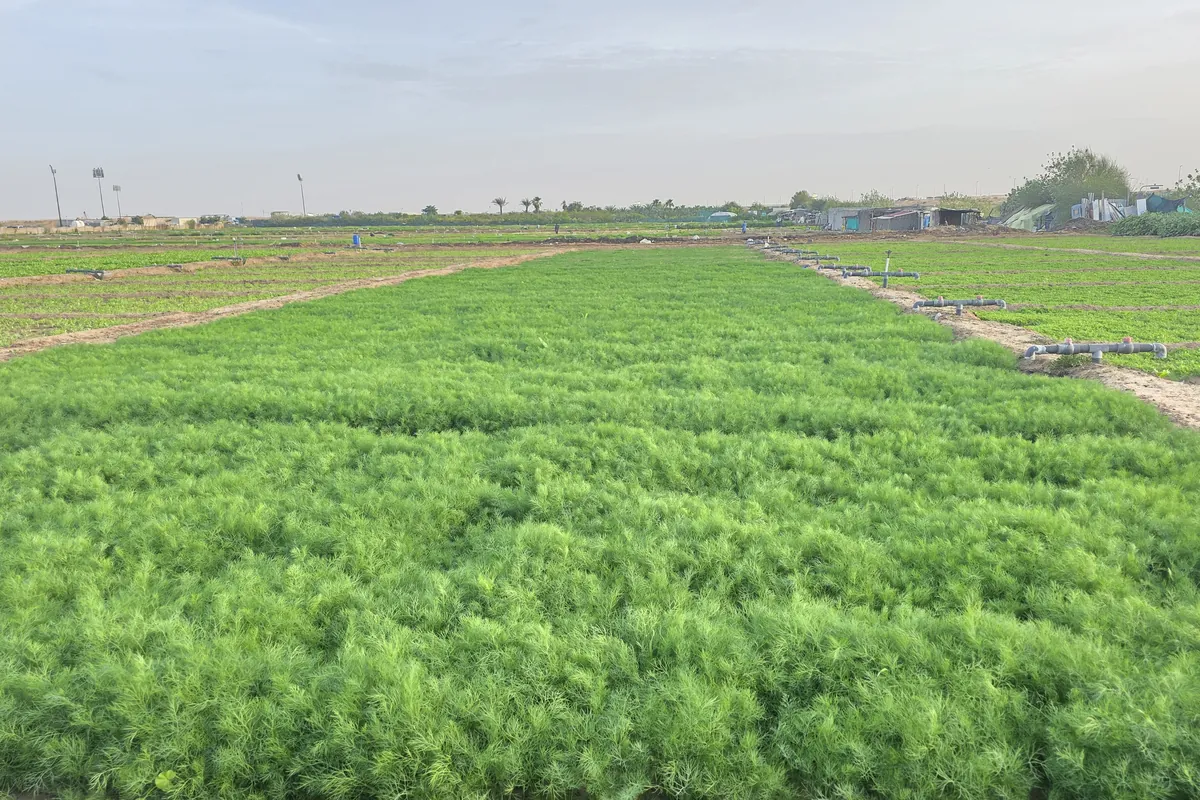
Nazwa Farm grows dill and 22+ other herbs and leafy vegetables in soil on the family farm in Nazwa, Sharjah. The farm was founded in 1999 by Md Mafzal Ahmed and supplies Sharjah, Dubai and Ajman daily, harvesting the same morning with no middleman in between. See the range we send to the waterfront on our fresh herb supply for Al Majaz, Al Khan and Al Taawun.
Send your list, quantity and area on WhatsApp +971 50 936 9091 or email admin@nazwafarm.com, and your schedule is confirmed the same day. Herbs come in bundles packed in boxes of about 60 bundles, and farm pickup in Sharjah is available daily. Message us for today’s farm-direct price.
Frequently Asked Questions
What is dill called in Arabic?
Dill is called shabath (شبت) in Arabic, and Iraqi cooks often say shibint. In South Asian kitchens it is known as sowa or soya. When ordering from Nazwa Farm, any of these names is fine, and the farm lists it simply as Dill on its vegetable pages.
Can I use dried dill instead of fresh in dill rice?
Dried dill can work in a pinch, but it gives a duller, hay-like flavour and lacks the bright aroma that defines dill rice and fish dishes. For restaurant menus, fresh dill is the better choice. Add part of it during cooking and fold in the rest at the end for fragrance.
How long does fresh dill last in a restaurant chiller?
It depends on how fresh it was when bought and how it is stored. Dill cut the same morning and kept chilled, dry and loosely covered lasts noticeably longer than older stock. Check daily for yellow tips or slimy centres, and use the oldest bundles first.
Where can Sharjah restaurants buy fresh dill wholesale?
Sharjah restaurants can buy dill at markets, through distributors or from local farms. Nazwa Farm grows dill in Nazwa, Sharjah, and supplies restaurants daily, including in Al Majaz and Al Khan. Send your list on WhatsApp for today’s farm-direct price, or arrange daily pickup from the farm.
Key Takeaways
- Dill in Arabic cooking is used mostly with rice, fish, stuffed vegetables and yoghurt.
- For dill rice, use plenty of fresh dill and add it in two stages.
- Dill is delicate: buy it fresh, keep it dry and chilled, and chop it just before use.
- Order dill with parsley, coriander and mint to cover most Arabic herb mixes.
- Al Majaz and Al Khan restaurants can order same-morning dill from Nazwa Farm on WhatsApp.
Need fresh dill for your Al Majaz kitchen? Send your herb list today. Order on WhatsApp: +971 50 936 9091