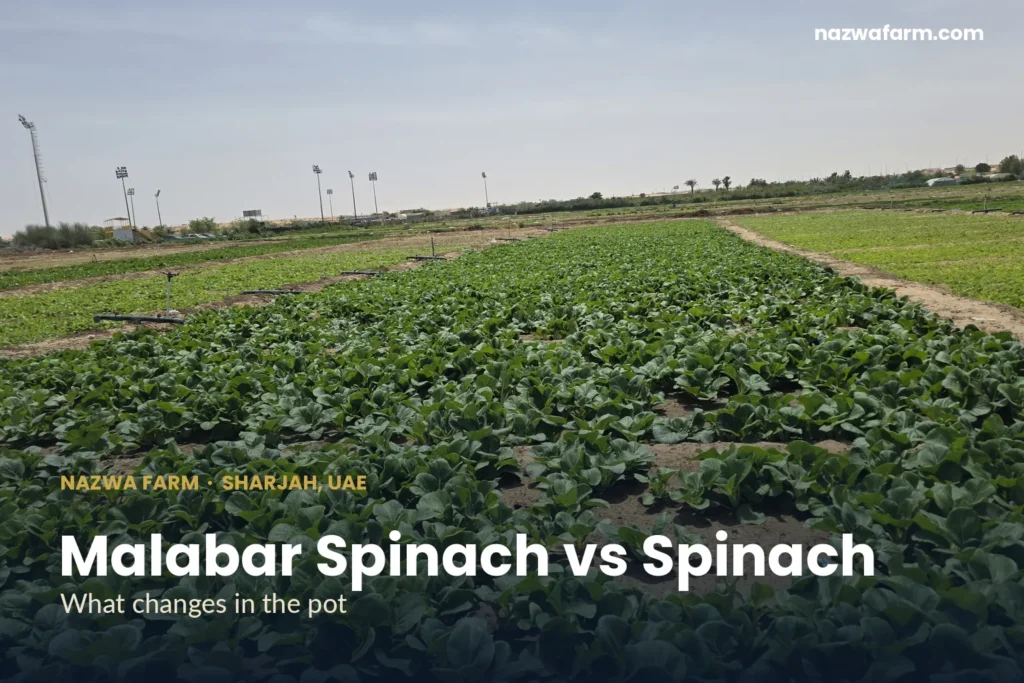
Quick answer: Malabar spinach vs spinach comes down to texture. Malabar spinach (Basella, pui shak) is a heat-loving vine with thick, glossy leaves that turn silky and slightly mucilaginous when cooked, thickening curries and soups. Regular spinach (palak) has thin leaves that collapse quickly and suit purées, dals and pastries. They are different plants.
Is Malabar spinach real spinach?
No. Malabar spinach (pui shak) belongs to the genus Basella, in its own family, Basellaceae. The green-stemmed form is usually called Basella alba; the red-stemmed form is often sold as Basella rubra. It is a climbing vine with thick, fleshy, shiny leaves.
Regular spinach (palak) is Spinacia oleracea, a low-growing leafy plant from the amaranth family. Its leaves are thinner and softer.
The shared name comes from the kitchen, not from botany: both are cooked as leafy greens. Malabar spinach goes by many names across the UAE’s communities, including pui shak or pui shaak in Bengali, mồng tơi in Vietnamese and alugbati in the Philippines.
Malabar spinach vs spinach: the key differences
Here is the comparison chefs ask for most, including the basella vs spinach points that affect cooking.
| Point | Malabar spinach (pui shak) | Spinach (palak) |
|---|---|---|
| Botanical name | Basella alba / Basella rubra | Spinacia oleracea |
| Growth habit | Climbing vine | Low rosette of leaves |
| Leaf | Thick, fleshy, glossy, heart-shaped | Thin, soft, flat or slightly crinkled |
| Stems | Thick, juicy, edible; green or red | Thin, short |
| Raw taste | Mild, slightly peppery and citrusy | Earthy, slightly mineral |
| Cooked texture | Silky, slightly slippery; thickens liquid | Collapses into soft leaves or purée |
| Heat tolerance in the field | Thrives in hot, humid weather | Prefers cooler weather; tends to bolt in heat |
| Classic uses | Bengali chorchori, fish and shrimp dishes, Vietnamese soups | Palak paneer, saag, dal, fatayer, salads |
What does Malabar spinach do in the pot?
The main thing Malabar spinach does is thicken. Its leaves and stems contain mucilage, the same kind of naturally slippery substance found in okra and moulokhia. In a curry or soup this gives a silky body without flour or cream.
That property shapes Malabar spinach cooking:
- Bengali pui shak chorchori: stems and leaves cooked with pumpkin, potato or aubergine and panch phoron, often with small fish or a fish head.
- Pui shak with shrimp: a home-style Bengali dish where the greens soften around prawns.
- Vietnamese canh: a light soup where mồng tơi gives the broth a gentle body.
- Filipino dishes: alugbati added to mung bean stews or sautéed with sardines.
Cook the chopped stems first, because they are thicker, then add the leaves. Stir gently; vigorous stirring makes the texture more slippery.
When should you choose palak instead?
Choose regular spinach when you want a smooth green colour, a fine purée or a dry filling. The pui shak vs palak choice is really a texture choice.
- Palak paneer and saag: spinach blends to a smooth, bright purée. Malabar spinach would make it gluey.
- Dal palak and aloo palak: spinach melts into the dish quickly.
- Fatayer and pies: spinach can be salted and squeezed dry for fillings; Malabar spinach holds too much moisture.
- Salads: young spinach works raw. Young Malabar spinach leaves can also be eaten raw, but their thicker texture suits fewer salads.
Common mistakes when switching between them
- Using Malabar spinach in a blended palak dish and getting a sticky sauce.
- Discarding Malabar spinach stems, which are tender and well liked in Bengali cooking.
- Overcooking spinach until it turns olive-grey.
- Planning portions by raw volume; both shrink, spinach most of all.
How should you store and prep each one?
Both are perishable leafy greens, but they fail in different ways. Malabar spinach leaves bruise and darken where they are crushed. Spinach yellows and turns slimy if it stays wet.
- Unpack on arrival and keep both out of warm areas.
- Store unwashed or well drained in lined, covered containers in the chiller.
- Do not pack Malabar spinach tightly; give the thick leaves space.
- Wash spinach in several changes of cold water, as grit settles in the leaves.
- Separate Malabar spinach stems and leaves at prep so each can be cooked for the right time.
Kitchens that also buy water spinach will find a similar comparison in our article on kangkong vs spinach.
Where to get pui shak and palak in Al Nahda, Sharjah
Al Nahda’s residential towers, supermarkets and South Asian restaurants make it a strong market for Bengali and Indian greens. Our herb and vegetable supply in Al Nahda, Sharjah covers puisak, spinach, red palak, mustard greens and coriander.
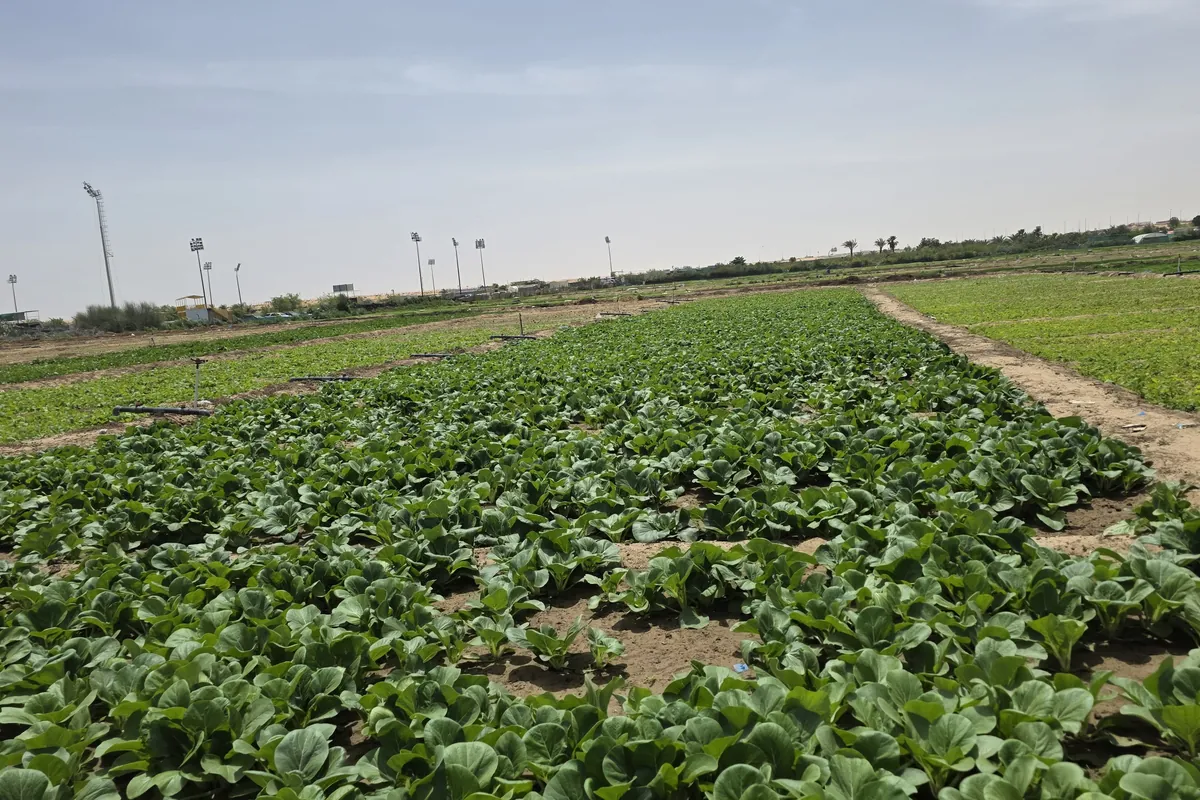
Nazwa Farm grows these greens in soil on our family farm in Nazwa, Sharjah, and harvests them the same morning they go out. We sell farm-direct to restaurants, supermarkets, groceries and traders, with daily supply across Sharjah, Dubai and Ajman and daily farm pickup in Sharjah.
To order, send your list, quantity and area on WhatsApp or email admin@nazwafarm.com, and we confirm the schedule the same day. For kitchens further away, our page on fresh vegetables in Fujairah explains how to check whether we can supply your area. For prices, message us for today’s farm-direct price.
Frequently Asked Questions
What is pui shak called in English?
Pui shak is called Malabar spinach in English. It is also known as Ceylon spinach, Indian spinach or vine spinach. Botanically it is Basella alba, with a red-stemmed form often sold as Basella rubra. In the Philippines it is called alugbati and in Vietnam mồng tơi.
Why is Malabar spinach slimy when cooked?
Malabar spinach contains mucilage, a naturally slippery substance also found in okra and moulokhia. When the leaves and stems are cooked, the mucilage is released into the liquid, giving soups and curries a silky, slightly thick texture. Gentle stirring and shorter cooking keep the effect milder.
Can I use Malabar spinach instead of spinach in palak paneer?
It is not a good swap. Malabar spinach will make the purée sticky and less smooth, and the colour will be different. For palak paneer, saag and other blended dishes, stay with regular spinach. Malabar spinach works better in chunky curries, chorchori, soups and stir-fries.
Are Malabar spinach stems edible?
Yes. The stems are thick, juicy and tender, and many Bengali cooks value them as much as the leaves. Trim any tough lower ends, cut the rest into short pieces and cook them a few minutes before the leaves so both finish at the same time.
Key Takeaways
- Malabar spinach (Basella) and regular spinach (Spinacia oleracea) are unrelated plants.
- Malabar spinach thickens dishes with its silky mucilage; spinach collapses into a smooth purée.
- Use pui shak for chorchori, fish and shrimp dishes and soups; use palak for saag, dal and fillings.
- Cook Malabar spinach stems before the leaves, and never discard them.
- Al Nahda kitchens can order both farm-direct from Nazwa, Sharjah, harvested the same morning.
Need pui shak, palak or other Bengali greens in Al Nahda or Sharjah? Send us your list and quantity. Order on WhatsApp: +971 50 936 9091