
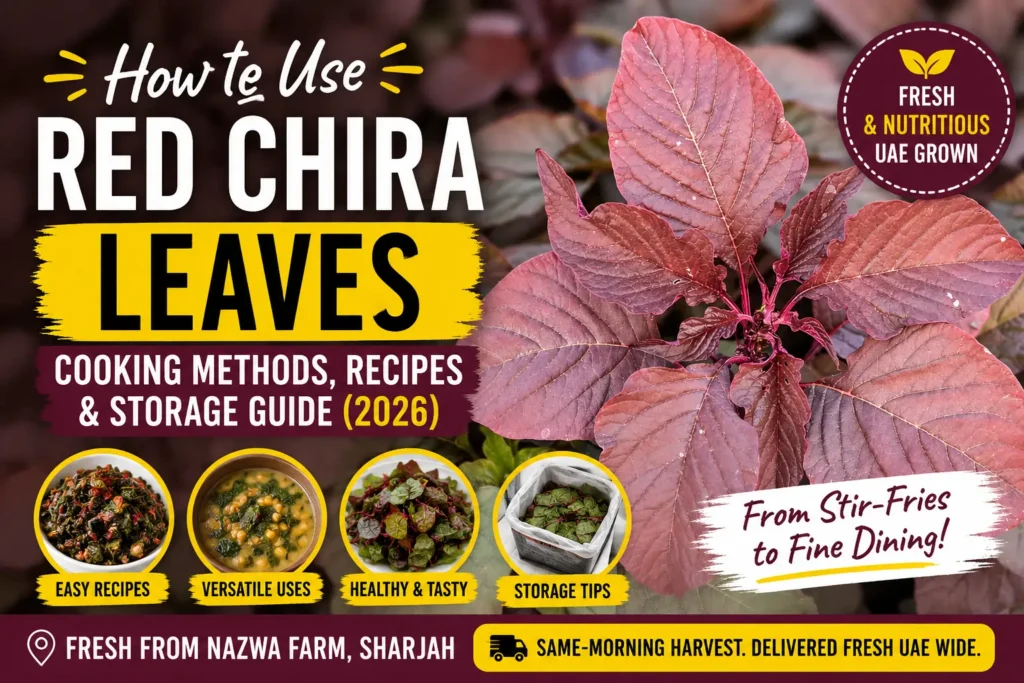
TL;DR
- Red Chira (also called Lal Shak, Lal Saag, red amaranth, or red palak) is a highly versatile leafy vegetable that works in stir-fries, soups, curries, salads, and fine dining plating.
- The most common way to cook Red Chira is the Bengali Bhaja method: stir-fried in mustard oil with garlic, dried red chili, and a pinch of salt for 4 to 6 minutes – nothing more needed.
- Both the leaves and the stems are edible and nutritious; do not discard the stems.
- Red Chira releases its own moisture when cooked – you do not need to add water.
- To store Red Chira, wrap the leaves in a damp paper towel, place in a plastic or reusable bag in the refrigerator, and use within 3 to 4 days for best freshness (Playful Cooking, 2024).
- Nazwa Farm grows and supplies fresh Red Chira with same-morning harvest from their Nazwa, Sharjah farm, delivering across Dubai, Sharjah, Ajman, and Abu Dhabi.
What Is Red Chira and What Does It Taste Like?
Red Chira is the Bengali community name for red amaranth leaves – the edible leaves of Amaranthus tricolor, a deep crimson-green leafy vegetable that is a staple in Bengali, South Asian, and many South-East Asian kitchens. In the UAE, it goes by several names: Lal Shak or Lal Saag in Bengali households, red palak in broader South Asian usage, red amaranth in English, and سبانخ أحمر in Arabic.
Young Red Chira leaves are slightly astringent when raw, with a mildly nutty and spinach-like taste. The younger leaves are mild and tender while the more mature leaves are slightly fibrous and develop a more pronounced flavor (Specialty Produce).
Red Chira is not the same plant as green spinach (Spinacia oleracea), even though it is sometimes called “red spinach.” It is a different plant entirely – from the Amaranthus family – with higher iron content, a more delicate cooking texture, and a distinctive deep crimson color that comes from anthocyanins and betalains.
The color is one of Red Chira’s most distinctive cooking qualities. When raw, the leaves are a dramatic red-green. When cooked, they deepen to a rich maroon-burgundy. This is why fine dining chefs in Dubai’s hotel restaurants specifically source it for visual impact on plating – the contrast against white ceramic is immediate.
What Parts of Red Chira Can You Eat?
You can eat the entire plant above the roots: leaves, stems, and even the young flower buds before they fully open.
Leaves: The primary edible part. Both young tender leaves and larger mature leaves are used. Younger leaves are milder and better for raw applications like salads. Larger leaves are better for cooking.
Stems: The stems are fully edible and should not be discarded. The stems are quite nutritious and worth including – chop the leaves along with the stems finely for even cooking (Playful Cooking, 2024). In many Bengali recipes, the stems add a slightly different texture to the finished dish, which is valued rather than avoided.
Young flower buds: Edible before they fully mature. Once the plant flowers and the blossoms become bushy and fully open, the leaves are considered past their prime for eating.
How to Prepare Red Chira Before Cooking
Proper preparation takes 5 minutes and makes a real difference to the final dish.
Step 1 – Select and sort the leaves. Remove any yellowed, wilted, or slimy leaves. When preparing bunches of amaranth leaves, always discard any soggy or wilted ones from the fresh batch to prevent moisture transfer (Slurrp, 2025).
Step 2 – Wash thoroughly. Fill a large bowl with cold water. Submerge the leaves and swirl them with your hands. Lift the leaves out of the water (do not pour the water over them – this puts the grit back on the leaves). Repeat once more with fresh water. The red pigment will bleed slightly into the water – this is normal and not a sign of damage.
Step 3 – Do not wash before storing. Only wash Red Chira immediately before cooking or eating. Washing and then storing wet leaves accelerates spoilage significantly.
Step 4 – Chop leaves and stems together. Cut into roughly 2 to 3 cm pieces. Fine chopping is standard in Bengali Bhaja recipes. Coarser cuts work for soups and curries where you want visible leaf pieces.
Step 5 – Drain briefly. A small amount of surface water on the leaves is fine and actually helps the leaves wilt quickly in a hot pan. Excessive water will make the leaves steam rather than stir-fry.
6 Ways to Use Red Chira Leaves
Red Chira works across a wider range of cooking methods than most people realize. It is not just a Bengali stir-fry ingredient – it has applications from traditional home cooking to fine dining plating.
Method 1: Bengali Bhaja (Classic Stir-Fry) – The Most Common Method
Bengali Bhaja is the traditional way Red Chira is cooked in Bangladesh and West Bengal – and the preparation most commonly made in South Asian homes across Dubai, Sharjah, Ajman, and Abu Dhabi. It is simple, fast, and produces a genuinely delicious result with very few ingredients.
What it produces: A wilted, deeply colored, fragrant side dish with a slightly earthy, savory flavor. Eaten alongside white rice and dal, this is the most familiar Red Chira preparation for the Bengali community.
Core method:
- Heat 1 tablespoon of mustard oil in a heavy-bottomed pan over medium-high heat until it reaches smoking point, then lower the heat slightly.
- Add half a teaspoon of black mustard seeds and 1 to 2 dried red chilies. Let them sizzle for 20 to 30 seconds until the mustard seeds begin to pop.
- Add 3 cloves of minced or sliced garlic. Stir for another 20 seconds.
- Add the chopped Red Chira leaves and stems (approximately 200 to 250g).
- Add salt to taste and toss everything together.
- Cook over medium heat, stirring regularly, for 5 to 8 minutes. The Red Chira will start to wilt and release its own water – this water is enough to cook the leaves and no additional water needs to be added (Avantika’s Kitchen, 2021).
- Once most of the liquid has evaporated and the leaves are tender, check seasoning.
- Optional: add a small knob of ghee just before serving for extra flavor.
Serve with: Steamed white rice and simple lentil dal. A squeeze of lemon on top brightens the whole dish.
Cooking time: 10 to 12 minutes total.
Method 2: Lal Shak Bhaja with Eggplant and Peanuts (Classic Bengali Variation)
This is a richer, more textured version of the basic Bhaja, traditional in both Bangladeshi and West Bengali cooking. The eggplant adds body and the peanuts add crunch.
Heat mustard oil to smoking point and temper with half a teaspoon of kalonji (nigella seeds), 2 dried red chilies, and 3 cloves of minced garlic. Once the spices sizzle and the garlic aroma releases, add diced eggplant with half a teaspoon of turmeric powder and sauté until the eggplant is lightly browned. Then add the red amaranth leaves and toss with the eggplant. Add salt and slit green chilies and cook until the leaves are tender (Bong Mom’s Cookbook, 2020).
Fry a handful of peanuts separately in oil until golden and add them as a final topping for crunch. Bori (lentil dumplings, available at South Asian grocers in Dubai) can be substituted for peanuts for a more traditional finish.
Method 3: Lal Saag with Poppy Seed Paste (Posto)
Posto – cooking Red Chira with a ground poppy seed paste – is one of the most distinctly Bengali preparations for this leaf. The poppy seed paste adds a nutty, slightly creamy coating to the leaves.
Soak poppy seeds in water for about 30 minutes, then grind with red chilies and a little water to make a thick paste. Heat mustard oil in a pan, add green chili and sauté for a few seconds, then add the chopped amaranth leaves and cook until softened. Add the poppy seed paste and mix thoroughly to coat the leaves. Add salt and cook for another 5 minutes or until most of the excess liquid dries out. Serve with plain rice and dal (PiggyLoveTales, 2020).
Poppy seeds (posto) are available in South Asian grocery stores in Dubai and Sharjah’s Al Wahda and Rolla areas.
Method 4: Bangladeshi Style with Shrimp, Onion, and Ginger
This is the Bangladeshi household variation – richer than the basic stir-fry, closer to a light curry, and well suited to serving as a main dish alongside rice.
The technique here uses the Bengali “koshano” method – carefully cooking onion, ginger, and garlic together until they form a unified, almost paste-like base before the leaves go in. This technique is important to the flavor: it involves spending real effort cooking the spice mix of onions, ginger, and garlic before adding the amaranth. The leaves taste somewhat like spinach with a deep rich maroonish red color (Kitchen Gatherings, 2025).
Core method:
- Fry sliced onion, minced ginger, and minced garlic together in oil over medium heat, stirring regularly, until they are deeply golden and softened to a paste – approximately 10 to 12 minutes.
- Add cleaned shrimp (or omit for a vegetarian version). Sauté until pink.
- Add the Red Chira leaves, salt, and a pinch of turmeric. Toss to combine.
- Cook for 5 to 7 minutes until the leaves are wilted and the excess moisture evaporates.
This preparation works especially well with small dried shrimp (chingri) if fresh shrimp is not available.
Method 5: Soups, Curries, and Dal
Red Chira is a natural addition to both South Asian and pan-Asian soups and curries. It does not need long cooking time – add it in the final 5 minutes of any soup or curry recipe, just long enough to wilt without losing color and texture.
Amaranth leaves can be added raw to salads or used in stir-fries, soups, and curries in similar ways to spinach and other leafy greens (Fine Dining Lovers).
In dal (lentil soup): Add a large handful of washed Red Chira leaves to any cooked dal 3 to 4 minutes before serving. Stir in, cover, and let the residual heat wilt the leaves. This adds iron, color, and flavor without altering the dal’s base taste significantly.
In Thai or South-East Asian soups: Red Chira replaces morning glory, kangkong, or spinach in most South-East Asian broth-based soups. Add in the final 2 minutes of cooking.
In chickpea stew: A one-pot amaranth leaves and chickpea stew using olive oil, onion, garlic, cumin, smoked paprika, vegetable broth, chickpeas, diced tomatoes, and roughly chopped amaranth leaves is a satisfying and filling dish (Must Eat Food, 2026). This preparation is particularly well suited to the UAE market, where chickpea-based dishes are familiar across multiple cuisines.
Method 6: Raw Salads and Fine Dining Garnish
Red amaranth leaves may be consumed raw when young and tender. Young leaves are slightly astringent with a mildly nutty, spinach-like taste and work well in raw applications (Specialty Produce).
For raw use, stick to the youngest, smallest leaves from the top of the plant. Larger, older leaves become more fibrous and bitter when uncooked.
Simple raw salad: Combine young Red Chira leaves with sliced red onion, halved cherry tomatoes, olive oil, lemon juice, and a pinch of black pepper. The leaves add color and a mild nutty bitterness that works well with the acidity of lemon.
Fine dining plating: Red amaranth greens are most commonly used as a garnish in fine dining, added to enhance the aesthetic appeal and overall dining experience. They have a mild, earthy flavor that complements both sweet and savory dishes and can be piled over salmon, pasta, placed in sandwiches, or served over quinoa (Specialty Produce).
For hotel chefs and fine dining restaurants in Dubai sourcing Red Chira specifically for plating: same-morning harvest from Nazwa Farm ensures the crimson color is fully intact at delivery. Cold-chain imports arrive with faded color – a problem that matters on a white ceramic plate.
Red Chira Cooking: Comparison Table
| Method | Cooking Time | Best For | Flavor Profile |
|---|---|---|---|
| Bengali Bhaja (basic) | 10-12 min | Home cooking, rice accompaniment | Earthy, savory, slightly pungent from mustard oil |
| Bhaja with Eggplant and Peanuts | 20-25 min | Weekend cooking, more textured dish | Richer, nutty, slightly smoky |
| Posto (poppy seed paste) | 15-18 min | Traditional Bengali kitchen | Nutty, creamy, earthy |
| With Shrimp and Ginger | 20-25 min | Main dish over rice | Savory, slightly sweet, full-bodied |
| In Soup or Dal | 3-5 min added | Quick nutritional boost to any broth | Takes on the flavor of the base dish |
| Raw in Salad or as Garnish | No cooking | Fine dining, health bowls, salads | Mild, nutty, slightly astringent |
What Red Chira Pairs Well With
Red Chira has a mild enough flavor to pair with a wide range of other ingredients. These pairings work across multiple cooking methods:
Oils: Mustard oil is the traditional choice in Bengali cooking and adds a pungent, sharp aroma that suits the earthy leaves. Olive oil works for Mediterranean-inspired preparations. Coconut oil pairs well with South Indian versions.
Aromatics: Garlic is the most universal pairing. Ginger works well in the Bangladeshi style. Dried red chili adds heat without competing with the leaf’s flavor. Fresh green chili adds a cleaner heat.
Proteins: Shrimp (chingri) is the most traditional protein pairing in Bengali cooking. Lentils pair naturally in dal preparations. Tofu works well in stir-fry applications for vegetarian diners. Chickpeas create a filling one-pot meal.
Grains and starches: Steamed white rice is the classic accompaniment for most Bengali preparations. Brown rice and quinoa work for health-focused serving. Chapati or roti is a common alternative to rice.
Spices and seeds: Black mustard seeds, kalonji (nigella seeds), turmeric, and cumin all work with Red Chira. Poppy seeds are the most traditional addition in Bengali cooking specifically.
Citrus: A squeeze of lemon or lime added after cooking brightens the finished dish and also increases iron absorption from the leaves – a practical nutritional pairing.
How to Store Red Chira Correctly
Fresh Red Chira has a short window before quality drops. Proper storage makes the difference between using leaves at peak flavor and throwing them out.
Do not wash before storing. Wash Red Chira only immediately before cooking. Wet leaves in storage develop slime and deteriorate significantly faster.
Refrigerate immediately. To store Lal Saag, wrap the leaves in a damp paper towel and place them in a plastic or reusable bag in the refrigerator. Use within 3 to 4 days for maximum freshness (Playful Cooking, 2024).
Use the crisper drawer. Store fresh leafy greens at temperatures between 0 to 4.4°C for best freshness (Discover Texas Real Food, 2024). The crisper drawer in most refrigerators maintains both the right temperature and humidity level for leafy greens.
Remove wilted leaves before storing. When storing bunches of amaranth leaves, discard any soggy or wilted ones from the fresh batch, as they accelerate decay of the leaves around them (Slurrp, 2025).
Freezing for longer storage: Blanch cleaned leaves in boiling water for 60 seconds, transfer immediately to ice water, drain well, and freeze flat in airtight bags. Frozen Red Chira is suitable for cooked applications (soups, curries, dal) but not for raw use or fine dining plating.
Signs that Red Chira has passed its best: yellowing leaves, slimy texture on stems, a fermented or sour smell, and significant color fading from the vivid crimson to a dull brown-red. All of these indicate the leaves should not be eaten.
Red Chira vs Other Leafy Greens: Cooking Differences
Understanding how Red Chira behaves in the pan compared to other common greens helps avoid common cooking mistakes.
| Leafy Green | Cooking Time | Releases Water? | Can Eat Raw? | Color Change When Cooked |
|---|---|---|---|---|
| Red Chira (red amaranth) | 5-8 min | Yes – significantly | Yes (young leaves only) | Vivid red deepens to maroon-burgundy |
| Spinach (palak) | 2-3 min | Yes | Yes | Bright green turns dull olive |
| Methi (fenugreek) | 4-6 min | Minimal | No – very bitter | Stays dark green |
| Mustard leaves | 6-8 min | Moderate | No – too sharp | Dark green, slightly yellowish |
| Moulokhia | 4-5 min | Significant | No | Dark green, becomes mucilaginous |
Key differences to know:
- Red Chira wilts faster than mustard leaves but slower than spinach. Do not overcook it – 5 to 8 minutes is enough.
- The water released during cooking is naturally tinted red from the pigments. This is normal and adds color to the dish.
- Red Chira holds its shape better than spinach when cooked. It will not reduce to near-nothing the way spinach does in a pan.
Common Mistakes When Cooking Red Chira
- Adding water to the pan: Red Chira releases enough of its own moisture as it wilts. Adding extra water steams the leaves instead of stir-frying them, producing a wet, colorless result instead of a vibrant, concentrated dish.
- Overcooking: More than 8 to 10 minutes of direct heat causes the leaves to lose both color and nutritional value. The betalains and vitamin C that give Red Chira its health properties are heat-sensitive – stop cooking as soon as the leaves are wilted and tender.
- Discarding the stems: The stems contain comparable nutritional value to the leaves and are completely edible. Chopping them finely and adding them with the leaves gives both better texture and better nutrition.
- Using the wrong oil: Neutral oils like sunflower oil work, but they produce a flat-tasting result. Mustard oil is the traditional and most flavorful choice. If mustard oil is unavailable, coconut oil or ghee give the most interesting result.
- Washing too far in advance: Red Chira deteriorates quickly once wet. Wash and chop only when you are ready to cook.
- Cooking old or wilted leaves: Faded, yellowing, or slimy leaves cannot be rescued by cooking. They taste bitter and unpleasant. Start with the freshest leaves possible – which is why same-morning harvest matters.
Where to Get Fresh Red Chira in Dubai, Sharjah, Ajman, and Abu Dhabi
The quality of your Red Chira directly determines the quality of the finished dish. Leaves that were harvested two or three days ago have already lost color vibrancy, anthocyanin concentration, vitamin C content, and flavor depth compared to same-day harvest leaves.
Nazwa Farm – founded in 1999 by Md Mafzal Ahmed in Nazwa, Sharjah – is one of the UAE’s very few farms growing fresh red palak wholesale consistently. The dramatic crimson-green color and high iron content make this a specialist crop in high demand, with UAE’s Bengali community specifically seeking fresh red palak for everyday lal saag shak, and Dubai’s hotel fine dining and premium restaurant segment sourcing it for visually dramatic plating (nazwafarm.com, 2026).
Nazwa Farm grows Red Chira on real UAE soil, not hydroponically. The leaves are cut before sunrise and delivered the same morning – which is why the crimson color arrives fully intact, not faded.
Who Nazwa Farm supplies:
- South Asian and Bengali home buyers and community F&V shops in Dubai, Sharjah, and Ajman
- Restaurants across all cuisines including Bengali, Indian, South-East Asian, and fine dining
- Hotel executive chefs requiring premium garnish quality
- Supermarkets and wholesale buyers across four Emirates
How to order:
- WhatsApp: +971 50 936 9091
- No minimum order, no contracts
- Delivery to Dubai, Sharjah, Ajman, and Abu Dhabi
- Same-day response guaranteed
- Order in English, Arabic, Urdu, or Bengali
Visit nazwafarm.com/vegetables/red-palak for more details on supply, pricing, and available quantities.
Frequently Asked Questions About How to Use Red Chira Leaves
What is the best way to cook Red Chira leaves?
The most reliable method is the Bengali Bhaja: heat mustard oil until smoking, add mustard seeds and dried red chili, then add minced garlic, then add the chopped Red Chira leaves and stems with salt. Stir-fry over medium heat for 5 to 8 minutes without adding water. The leaves release their own moisture. Serve with steamed rice and dal.
Can you eat Red Chira leaves raw?
Yes, but only the youngest, most tender leaves. Young Red Chira leaves are mildly nutty and slightly astringent, similar to baby spinach, and work in raw salads or as a garnish. Larger, more mature leaves are best cooked – they become fibrous and more bitter when uncooked.
How do you stop Red Chira from losing its color when cooking?
Cook on high heat for a short time – 5 to 8 minutes maximum. Long, slow cooking causes the anthocyanin and betalain pigments to break down and the color fades from vivid crimson to dull brown. Quick stir-frying over high heat preserves far more of the red pigment than slow braising or boiling.
Do you add water when cooking Red Chira?
No. Red Chira releases significant moisture as it wilts in the pan – enough to cook the leaves fully without any added water. Adding water produces steamed, pale leaves rather than a properly stir-fried result.
Can you use the stems of Red Chira, or only the leaves?
Both the leaves and stems are edible and should be used together. The stems are fully nutritious. Chop them to the same size as the chopped leaves so they cook evenly.
How long does fresh Red Chira last in the fridge?
Fresh Red Chira lasts 3 to 4 days in the refrigerator when stored correctly: wrapped in a damp paper towel, placed in a sealed bag, and kept in the crisper drawer. Do not wash before storing – wet leaves deteriorate much faster.
Where can I buy fresh Red Chira in Dubai or Sharjah?
Nazwa Farm is one of the very few UAE farms growing Red Chira (also called Lal Saag, red palak, or red amaranth) on real soil. They deliver same-morning harvested leaves to buyers across Dubai, Sharjah, Ajman, and Abu Dhabi. Order via WhatsApp at +971 50 936 9091 with no minimum order and no contracts. Visit nazwafarm.com for more.
What other leaves from Nazwa Farm go well with Red Chira?
Red Chira combines well with spinach (palak) in stir-fries for a two-color dish. Methi (fenugreek) adds a pleasant bitterness as a counterpoint in mixed saag preparations. Mustard leaves can be combined for a more traditional saag. All three are grown and available from Nazwa Farm alongside Red Chira.
Key Takeaways
- Red Chira (Lal Shak) is a versatile leafy vegetable that works across Bengali stir-fries, soups, dal, curries, raw salads, and fine dining garnish.
- The leaves and stems are both edible and nutritious – always include the stems.
- The classic Bengali Bhaja method – mustard oil, garlic, dried chili, no added water – produces the best result in under 12 minutes.
- Cook quickly at high heat to preserve the vivid crimson color; long cooking destroys the pigments responsible for both color and health benefits.
- Store unwashed in a damp paper towel in the refrigerator and use within 3 to 4 days.
- The quality of the raw leaves determines the quality of the finished dish. Same-morning harvested Red Chira from Nazwa Farm arrives with full color vibrancy and peak flavor that days-old cold-chain imports cannot match.
Nazwa Farm is a UAE soil farm established in 1999, growing and supplying 22+ varieties of fresh leafy vegetables and herbs directly to restaurants, hotels, supermarkets, and home buyers across Dubai, Sharjah, Ajman, and Abu Dhabi. Order Red Chira and other fresh leaves via WhatsApp: +971 50 936 9091 or visit nazwafarm.com/vegetables/red-palak.