
TL;DR
- Methi leaves (fenugreek leaves, حلبة خضراء) are one of the most versatile leafy vegetables in South Asian cooking – used in flatbreads, rice, lentil dal, vegetable stir-fries, meat curries, and as a flavoring herb.
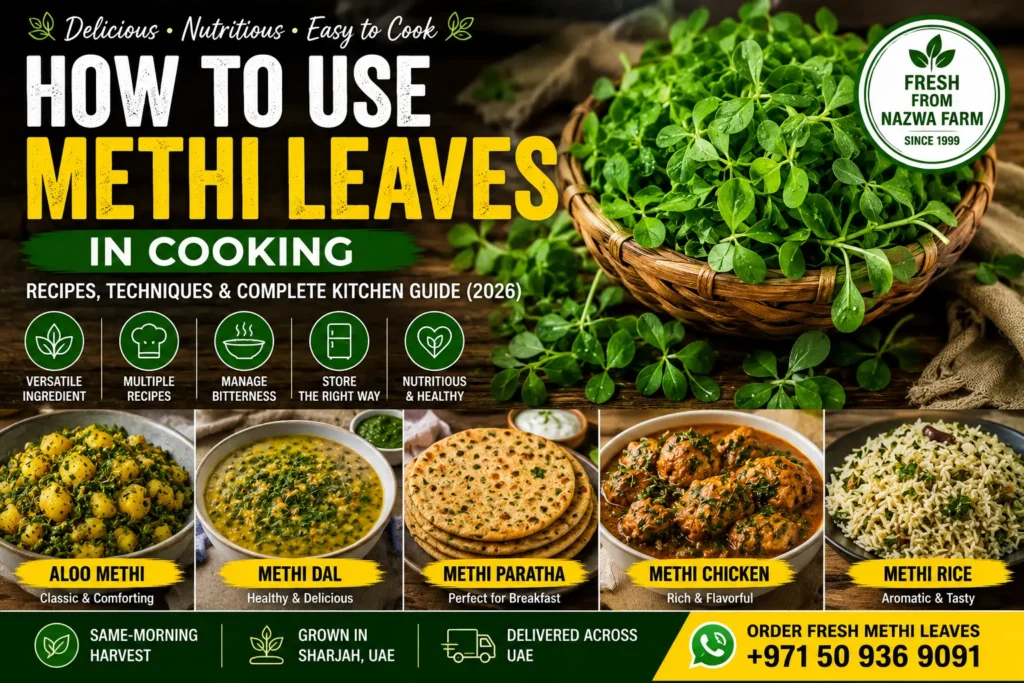
- The five most common uses of fresh methi leaves are: Aloo Methi (potato stir-fry), Methi Dal (lentil curry), Methi Paratha (flatbread), Methi Chicken or Gosht (meat curry), and Methi Rice (pulao).
- The bitterness of methi leaves is easy to manage: soak chopped leaves in salted water for 15 to 30 minutes, squeeze out the liquid, and the harsh edge is gone while the flavor stays intact.
- Do not wash methi before storing – always wash immediately before cooking. Stored correctly in a paper-towel-lined container in the refrigerator, fresh methi lasts 5 to 10 days.
- Nazwa Farm grows and supplies fresh methi (fenugreek leaves) with same-morning harvest from their Nazwa, Sharjah farm – one of the very few UAE farms growing this specialist crop consistently – delivering to Dubai, Sharjah, Ajman, and Abu Dhabi.
What Are Methi Leaves and What Do They Taste Like?
Methi leaves are the fresh green leaves of the fenugreek plant (Trigonella foenum-graecum), a legume-family herb widely grown across South Asia, the Middle East, and North Africa. In Arabic they are called حلبة خضراء (fresh hulba). In Indian and Pakistani cooking, the fresh leaves are called methi or methi saag. The dried version – known as kasuri methi – is a different product used as a concentrated flavoring herb, not a vegetable.
Methi is essential in Indian, Pakistani, and Sri Lankan cooking – used in methi dal, methi curry, methi thepla, methi gosht, and as a flavoring herb in numerous dishes (Nazwa Farm, 2026).
Raw methi leaves taste bitter and slightly nutty, with an aroma that is distinctly their own – not quite any other herb. Once cooked, the bitterness mellows considerably, and the leaves develop a warm, earthy depth that pairs well with starchy vegetables like potatoes, with lentils, with dairy (yogurt, cream, paneer), and with meat. The bitterness is a feature, not a flaw – it is what makes methi-based dishes taste complex and satisfying rather than flat.
Understanding how to manage the bitterness level is the single skill that separates good methi cooking from mediocre methi cooking, and this guide covers that directly.
How to Prepare Methi Leaves Before Cooking
Preparation takes 10 to 30 minutes depending on whether you are reducing bitterness. Follow these steps in order every time you cook fresh methi.
Step 1 – Select the Leaves
Pull the leaves from the stalks, discarding any yellowed, slimy, or very woody stems. Select small bunches of methi leaves, avoiding the matured ones as they tend to be more bitter (Masterchef Pankaj Bhadouria, via Slurrp, 2024).
Tender stems attached to young leaves are fine to include – they add texture and their bitterness is mild. Only the older, thicker main stalks need to go.
Step 2 – Wash Thoroughly
Fill a large bowl with cold water. Add the leaves and swirl them around. Lift the leaves out (do not pour the water through them – this puts the grit back) and discard the dirty water. Repeat until no grit settles at the bottom of the bowl – typically two to three rinses.
Spray some vinegar and sprinkle some salt over the leaves, leave for 5 minutes, then rinse well several times. This helps to get rid of pesticide residue (Swasthi’s Recipes, 2022).
Step 3 – Reduce the Bitterness (If Needed)
This step is optional but recommended for anyone who finds raw methi too intense, or when cooking for children.
Place the cleaned and chopped methi leaves in a bowl and sprinkle about a teaspoon of salt over them for a large bunch. Gently toss the leaves with your hands to distribute the salt evenly. Let the leaves sit for 15 to 20 minutes – water will pool at the bottom of the bowl containing a lot of the bitterness. After 20 minutes, take handfuls of the methi and squeeze them firmly to wring out as much of the green liquid as possible. Discard the bitter liquid. Remember to adjust the salt in your recipe, as the leaves will have absorbed some (Eat Healthy 365, 2025).
An alternative approach: blanch the methi leaves in boiling water to which lemon juice and salt have been added, then rinse immediately in cold water to reduce bitterness (Vaya Recipes, 2019).
Step 4 – Chop
After cleaning and drying, gather the leaves into a tight bunch and roughly chop them. A coarse chop is perfect – it helps the leaves integrate better into the dish and releases their flavor more evenly during cooking (Eat Healthy 365, 2025).
Fine chopping is standard for flatbreads like paratha and thepla where the leaves go into dough. Coarser chopping works for stir-fries, dal, and curries where visible leaf pieces are part of the dish.
Step 5 – Drain Before Adding to Hot Pan
Pat the leaves lightly dry or let them drain in a colander for a minute before adding to a hot pan. Wet leaves added to oil cause splashing and result in steaming rather than stir-frying.
The Bitterness of Methi: What Causes It and How to Manage It
The bitterness associated with methi leaves comes from compounds called saponins. While this bitterness can add depth to certain dishes, it may be overwhelming in others (Easy Clean Cook, 2025).
Bitterness is a “cleaner” – it cuts through fat and refreshes the palate – but there is a fine line between a sophisticated bite and a ruined meal. Sprinkling chopped leaves with salt and letting them sit for 15 minutes draws out the moisture and the most aggressive alkaloids, which are the source of bitterness. Squeezing the leaves dry and rinsing them leaves pure flavor without the harsh punch (Hassan Chef, 2026).
Four practical rules for bitterness management:
- Very fresh leaves are milder. Same-morning harvested methi from Nazwa Farm is milder in bitterness than leaves that have been sitting in cold storage for days. The bitterness intensifies with age.
- Salt soaking works. 15 to 30 minutes in salted water, then squeezing out the liquid, removes the most aggressive bitter compounds while keeping the earthy methi flavor.
- Yogurt and dairy neutralize bitterness. Adding curd, cream, or yogurt to any methi dish balances the bitter edge. Without using curd the use of methi does not taste good and therefore in order to get the right flavors of methi, use of dairy products such as yogurt, malai, or cream is essential for most curry preparations (Yummy Indian Kitchen, 2021).
- Cooking the methi uncovered allows excess moisture and bitterness to evaporate. Soaking methi leaves in salted water for about 30 minutes then squeezing them well before cooking helps reduce bitterness significantly (My Food Story, 2026).
7 Ways to Use Fresh Methi Leaves in Cooking
Fresh methi leaves work across a wider range of preparations than most cooks realize. The same bunch can make a dry stir-fry, a lentil curry, a flatbread, a meat dish, and a rice pulao – all with very different end results.
Method 1: Aloo Methi – The Classic Dry Stir-Fry
Aloo Methi is the most common everyday preparation for fresh methi across Indian, Pakistani, and Bangladeshi home kitchens – and one of the most popular methi dishes among the South Asian community in Dubai, Sharjah, and Ajman. It is a dry vegetable stir-fry (sabzi) of potatoes and fenugreek leaves cooked with minimal spices.
What it produces: A dry, earthy, slightly bitter vegetable dish with soft potatoes and wilted, fragrant methi. Eaten with roti or paratha as a primary side dish.
Core method:
- Pluck and wash 2 packed cups of methi leaves. Optionally soak in salted water for 15 minutes and squeeze dry.
- Peel and dice 2 medium potatoes into 1cm cubes. Soak in a bowl of water while prepping the methi – this helps them cook faster and prevents browning.
- Heat 2 tablespoons of oil in a pan on medium heat. If using mustard oil, heat it well until really hot and then lower the heat before adding the cumin seeds (Cook With Manali, 2019). Add half a teaspoon of cumin seeds and let them sizzle.
- Add 2 to 3 cloves of minced garlic and optional dried red chili. Stir for 20 seconds.
- Drain the potato cubes and add them to the pan. Cook on medium heat for 6 to 8 minutes, stirring occasionally, until the potatoes are about 80% cooked and have a light golden edge.
- Add the chopped methi leaves, a pinch of turmeric, and salt to taste. Toss everything together.
- Cook uncovered once methi is added so excess moisture evaporates and the sabzi does not turn soggy (My Food Story, 2026). Cook for another 5 to 6 minutes until the potatoes are completely soft and the methi is wilted.
- Squeeze lemon juice over the top before serving.
Serve with: Roti, phulka, or paratha. Dal rice on the side makes a complete meal.
Cooking time: 20 to 25 minutes total.
Method 2: Methi Dal – Lentil Curry with Fenugreek Leaves
Methi Dal is arguably the most nutritious way to eat fresh methi – combining the iron, calcium, and fiber of the leaves with the protein of lentils in a single pot dish. It works as both a weekday staple and a more elaborate meal with layered flavors.
What it produces: A semi-thick lentil curry with visible methi leaves and a distinctive earthy-bitter note from the fenugreek that makes it more complex than plain dal.
Core method:
- Pressure cook or boil 1 cup of toor dal (pigeon pea lentils), or a mix of toor, moong, and masoor dal, with water and a pinch of turmeric until completely soft.
- In a separate pan (kadai), heat 2 tablespoons of oil or ghee. Add mustard seeds and cumin seeds and let them splutter.
- Add chopped onion, green chili, and ginger-garlic paste. Cook until the onion is soft and golden – about 5 minutes.
- Add chopped tomatoes and cook until they break down – about 4 minutes. Add turmeric, red chili powder, and salt.
- Add one finely chopped bunch of methi and cook until the leaves reduce in volume – about 3 to 4 minutes (Hebbar’s Kitchen, 2024).
- Add the cooked dal with enough water to reach your preferred consistency. Let it simmer for 5 minutes.
- Finish with a squeeze of lemon and fresh coriander if available.
Serve with: Steamed basmati rice or jeera rice. Works equally well with roti.
Cooking time: 30 to 35 minutes including dal cooking time.
Tip: A slight, unique bitterness from fresh methi leaves is actually pleasing to the palate when combined with lentils (Spice Up The Curry, 2023). Do not over-salt trying to correct the bitterness – it works with the lentils, not against them.
Method 3: Methi Paratha – Flatbread with Fresh Fenugreek Leaves
Methi Paratha is a whole wheat flatbread with fresh methi leaves kneaded directly into the dough. It is one of the most popular Indian breakfast and lunchbox preparations and is common in Gujarati, Punjabi, and North Indian kitchens across the UAE.
What it produces: A soft, slightly bitter, fragrant flatbread speckled with green methi. Eaten with yogurt, pickle, dal, or any dry sabzi.
Core method:
- Wash and finely chop 1 cup of fresh methi leaves (stalks removed or tender stalks included). Optionally sprinkle with a pinch of salt, rest 5 minutes, and squeeze out the moisture to reduce bitterness.
- In a mixing bowl, combine 2 cups of whole wheat flour (atta), the chopped methi leaves, half a teaspoon of carom seeds (ajwain), a pinch of turmeric, red chili powder, ginger paste, and salt to taste.
- Adding curd to methi leaves reduces bitterness and makes the paratha super soft (Hebbar’s Kitchen, 2026). Add 2 tablespoons of plain yogurt and mix everything together. Add water a little at a time and knead into a soft, non-sticky dough. Add 1 tablespoon of oil and knead for another 2 minutes.
- Rest the dough covered for 20 minutes.
- Divide into 8 portions. Roll each portion into a disc about 6 to 7 inches in diameter on a floured surface.
- Cook on a tawa (flat griddle) until golden spots appear on both sides. Flip and apply a little oil or ghee on each side and cook by pressing with a spatula until cooked through (Swasthi’s Recipes, 2022).
Serve with: Plain yogurt, mango pickle, green chutney, or any dal.
Cooking time: 10 minutes prep (plus 20 minutes resting), 20 minutes cooking.
Method 4: Methi Chicken (Methi Murgh) – The Restaurant Standard
Methi Chicken is one of the most widely ordered dishes in South Asian restaurants across Dubai and the UAE. The fresh methi leaves add a distinctive earthy bitterness that balances the richness of the yogurt-based gravy. It is also straightforward to make at home.
What it produces: A medium-bodied chicken curry with a fragrant, slightly bitter methi flavor layered through the gravy. More elegant and less heavy than a plain chicken curry.
Core method:
- Wash 1.5 to 2 cups of fresh methi leaves thoroughly. Do not use the stalks or thick stems as they are mostly bitter. Chop the leaves a few times only – not finely (Swasthi’s Recipes, 2022).
- In a bowl, marinate 500g of chicken pieces with salt, turmeric, red chili powder, and 3 tablespoons of yogurt for at least 20 minutes.
- Heat oil in a heavy pot. Add whole spices: 1 bay leaf, 2 cardamoms, a small piece of cinnamon, 2 cloves.
- When the spices begin to sizzle, add chopped onions and green chili. Cook until golden. Add ginger garlic paste and sauté until a nice aroma comes out – about 50 to 60 seconds. Lower the flame and stir in chili powder and turmeric (Swasthi’s Recipes, 2022).
- Add the marinated chicken and cook on medium-high heat for 8 to 10 minutes, stirring regularly, until the chicken is browned and most of the marinade moisture has cooked off.
- Add the fresh methi leaves and stir to combine. Cook for 5 to 6 minutes until the leaves wilt completely and their aroma comes through.
- Add a splash of water if the gravy needs more liquid. Simmer for 10 minutes until the chicken is fully cooked. Finish with garam masala.
Serve with: Basmati rice, jeera rice, or paratha.
Cooking time: 40 to 50 minutes total including marination.
Method 5: Methi Gosht – Slow-Cooked Meat Curry with Fenugreek
Methi Gosht – methi with mutton or lamb – is a Pakistani and Punjabi classic. The slow-cooked meat absorbs the bitter warmth of the methi over a longer cooking time, producing a more integrated flavor than the chicken version.
The method follows the same base as Methi Chicken above, replacing chicken with mutton or lamb cut into pieces. Mutton requires significantly longer cooking – 45 to 60 minutes at medium heat or 4 to 5 pressure cooker whistles – before the methi leaves are added in the final 10 minutes. Adding the methi too early in a long-cooked meat dish can turn the flavor harsh and overpowering.
Method 6: Methi Dal Rice (Methi Pulao)
Methi Pulao is a one-pot fragrant rice dish cooked with fresh fenugreek leaves and mild spices. It works as a standalone meal or as a side rice dish alongside dal and sabzi.
Core method:
- Wash and soak 1 cup of aged basmati rice for 15 to 20 minutes. Drain.
- Pour 1 tablespoon of oil into a hot pan. Add half a teaspoon of cumin seeds, 1 to 2 chopped garlic cloves, 2 green cardamoms, and a slit green chili. When the garlic is lightly fried, add 1.25 cups of chopped methi leaves and half a cup of green peas (Swasthi’s Recipes, 2023).
- To get rid of the bitterness effectively, clean, wash, chop finely, and soak the methi in salted water for 30 minutes, then squeeze dry before adding to the pan (Tomato Blues, 2021).
- Sauté the methi with the aromatics for 2 to 3 minutes until slightly wilted.
- Drain the rice and add to the pan. Stir to coat in the oil and spices for 1 minute.
- Add 2 cups of water, salt to taste, and bring to a boil. Lower the heat, cover, and cook until the water is absorbed and the rice is fluffy – about 15 minutes.
Serve with: Plain yogurt raita and papad.
Method 7: Methi Thepla – Gujarati Flatbread for Travel and Lunchboxes
Methi Thepla is a thinner, crispier version of methi paratha from Gujarati cuisine. It is famous in the UAE’s large Gujarati community and is specifically made to last longer than regular paratha – making it popular for packed lunches and travel food.
The method is similar to Methi Paratha above with two differences: thepla uses a mix of wheat flour and chickpea flour (besan) for a firmer texture, and it is rolled thinner. You will need half a cup of fresh methi leaves for every cup of atta (Swasthi’s Recipes, 2022). Thepla are rolled to a thinner disc than paratha, cooked on a tawa with a small amount of oil, and pressed firmly with a spatula for even cooking. They keep well for 2 to 3 days without refrigeration.
Methi Cooking: Comparison Table
| Preparation | Cooking Time | Cuisine | Best Served With | Bitterness Level |
|---|---|---|---|---|
| Aloo Methi | 20-25 min | North Indian / Punjabi | Roti, paratha | Medium – pleasant |
| Methi Dal | 30-35 min | Pan-Indian | Steamed rice or roti | Mild – absorbed by lentils |
| Methi Paratha | 30 min | North Indian / Punjabi | Yogurt, pickle, dal | Low – diluted in dough |
| Methi Chicken | 40-50 min | North Indian / Pakistani | Basmati rice, paratha | Medium – balanced by yogurt gravy |
| Methi Gosht | 75-90 min | Pakistani / Punjabi | Rice, naan | Medium-low – mellowed by long cooking |
| Methi Pulao | 30-35 min | Pan-Indian | Raita, papad | Low – diluted in rice |
| Methi Thepla | 30 min | Gujarati | Yogurt, pickle, mango chutney | Very low – diluted in dough |
What Pairs Well With Methi Leaves
Methi’s bitter-nutty flavor works in specific combinations. Knowing these pairings helps you use it confidently in unfamiliar recipes.
Starches and grains that balance methi well: Potatoes absorb and soften methi’s bitterness better than any other vegetable. Whole wheat flour in flatbread dough dilutes it to a pleasant background note. Basmati rice distributes it evenly in every grain.
Dairy that neutralizes bitterness: Plain yogurt is the most effective dairy partner for methi in curries and parathas. Without dairy products such as yogurt, malai, or cream, the use of methi does not taste good in curry preparations (Yummy Indian Kitchen, 2021). Ghee added at the end of cooking softens the overall flavor of any methi dish.
Lentils and legumes: Toor dal, moong dal, and masoor dal all pair well with methi leaves. The earthiness of lentils and the bitter warmth of methi are natural complements.
Proteins: Chicken, mutton, and lamb absorb methi flavor well. The fat in the meat softens the bitterness during cooking. For vegetarian proteins, paneer works very well in methi malai paneer – a restaurant classic.
Spices that complement methi: Cumin seeds, mustard seeds, turmeric, and garam masala are the most natural partners. Carom seeds (ajwain) are particularly good in flatbreads, as they enhance the digestive properties of the dish.
Aromatics: Garlic is essential – it bridges the gap between methi’s bitterness and the base flavors of any dish. Ginger adds warmth that balances the bitter edge.
How to Store Fresh Methi Leaves to Use All Week
Place the methi leaves inside a container lined with paper towels, spreading them out evenly. Cover the leaves with another paper towel, seal the container, and store in the fridge for up to 10 days (Sandhya’s Kitchen, 2025).
The critical rule: never wash methi before storing. Wet leaves in a sealed container develop slime and deteriorate within a day. Wash only immediately before cooking or immediately before use.
Short-term storage (up to 10 days):
- Separate the leaves from thick stems. Do not wash.
- Line an airtight container with a dry paper towel.
- Spread the leaves loosely – do not pack tightly.
- Cover with another paper towel and seal.
- Store in the crisper drawer of the refrigerator.
Longer-term storage by freezing (up to 3 months): Wash methi leaves 3 to 4 times to remove dirt, pat completely dry with a clean cloth, and chop roughly if desired. Spread on a tray to flash-freeze for 2 hours to prevent clumping, then transfer to a ziplock bag or airtight container, squeeze out air, and freeze flat (News9Live, 2026).
Frozen methi works well in cooked applications – dal, curries, pulao, and paratha dough. It should not be used in raw applications where texture and color matter.
Signs methi has passed its best: yellowing leaves, slimy stems, a fermented or sour smell, and a brownish color where leaves should be bright green. Start with the freshest leaves possible – which is why same-morning harvest from a UAE farm makes a real difference to shelf life and flavor.
Common Mistakes When Cooking With Methi Leaves
- Adding methi too early in long-cooked dishes. In slow-cooked meat curries, adding methi at the start of a 60-minute cook makes the flavor harsh and one-dimensional. Add methi in the final 5 to 10 minutes of cooking for curries, the last 3 minutes for dal, and only after the main ingredients are already partly cooked for stir-fries.
- Skipping the salt-soak for bitter batches. Not all methi is equally bitter. Older leaves and certain batches can be very sharp. If you bite a raw leaf and it tastes intensely bitter, do the salt soak before cooking. Fresh, same-morning methi from Nazwa Farm is generally milder and may not need soaking at all.
- Using too much methi in paratha dough. More methi is not always better in flatbreads. Too much makes the dough wet, difficult to roll, and the flatbread turns out fragile. Use half a cup of fresh methi leaves for every cup of atta (Swasthi’s Recipes, 2022).
- Washing and storing methi wet. Wet leaves in storage develop slime in 24 hours. Always wash immediately before cooking, never before storing.
- Covering the pan when cooking methi. Cooking the methi uncovered allows excess moisture and bitterness to evaporate. Covering the pan traps the bitter steam and recondenses it back into the dish (My Food Story, 2026).
- Discarding tender stems. Young tender stems have flavor and nutrition comparable to the leaves. Only the thicker, more mature main stalks need to be removed. Including tender stems reduces waste and improves the texture of stir-fries.
Methi Leaves in UAE Kitchens: 5 Quick Uses Beyond the Classics
For home cooks who want to use methi more frequently without cooking a full recipe:
- Add a handful to any dal in the last 3 minutes. This transforms a plain dal into a methi dal without any extra effort. No recipe change needed – just wash, chop, and stir in.
- Knead into roti dough. Add 2 tablespoons of finely chopped methi per cup of flour when making everyday roti. The leaves add flavor and nutrition without making the bread noticeably bitter.
- Stir into scrambled eggs. Add a small handful of washed, chopped methi leaves to scrambled eggs or an omelet. The leaves wilt instantly in the heat and add an earthy, savory dimension.
- Use as a finishing herb on rice. Finely chop a small amount of fresh methi and scatter over plain steamed rice with a drizzle of ghee and cumin seeds. This takes 2 minutes and transforms plain rice.
- Add to any Pakistani or Indian meat curry in the last 10 minutes. Fresh methi lifts the flavor of any basic curry. It does not need a dedicated recipe – just add washed, chopped leaves toward the end of cooking and let them wilt into the sauce.
Where to Get Fresh Methi in Dubai, Sharjah, Ajman, and Abu Dhabi
Methi (fenugreek leaves) is a specialist South Asian herb that very few UAE local farms grow consistently. Nazwa Farm is one of the very few UAE farms growing methi consistently – supplying South Asian restaurants, supershops, and F&V shops across Dubai, Sharjah, and Ajman with 25 years of farming experience (Nazwa Farm, 2026).
The quality of fresh methi directly affects both its flavor and how much preparation work it needs. Same-morning harvested methi from Nazwa Farm arrives with its characteristic aroma at peak, leaves fully vibrant, and bitterness at its most manageable – milder than older leaves that have been cold-stored for days. Days-old methi has a more aggressive bitterness and a shorter remaining shelf life from the moment it reaches your kitchen.
How to order from Nazwa Farm:
- WhatsApp: +971 50 936 9091
- No minimum order, no contracts
- Delivery to Dubai, Sharjah, Ajman, and Abu Dhabi
- Same-day response guaranteed
- Orders in English, Arabic, Urdu, or Bengali
You can also order methi alongside other fresh leaves – spinach (palak), mustard leaves, red chira, coriander, and more – all from the same farm in a single delivery. Visit nazwafarm.com/vegetables/methi for full supply details.
Frequently Asked Questions About Using Methi Leaves in Cooking
How do you remove the bitterness from methi leaves?
The most effective method is to chop the leaves, sprinkle generously with salt, mix well, and leave for 15 to 30 minutes. Water containing the bitter compounds will pool at the bottom of the bowl. Squeeze the leaves firmly to wring out as much liquid as possible and discard it. The methi is now ready to cook with significantly reduced bitterness. Cooking uncovered also lets residual bitterness evaporate rather than recondense into the dish.
Can you eat methi leaves raw?
Yes, small amounts of young, fresh methi leaves can be eaten raw – they are sometimes added to salads or used as a garnish. However, raw methi is quite bitter and most people prefer it cooked. Cooking mellows the bitterness and develops a much more pleasant, earthy flavor.
What is the difference between fresh methi and kasuri methi?
Fresh methi leaves are the green leaves used as a vegetable – added in quantity to make dal, aloo methi, paratha, and curries. Kasuri methi is the dried version used as a concentrated finishing herb – added in small pinches to enhance the aroma of a dish. They are not interchangeable in the same amounts. If substituting fresh for kasuri methi in a recipe, 1 tablespoon of kasuri methi equals approximately half a cup of fresh methi leaves.
How long do fresh methi leaves last in the refrigerator?
Stored correctly – dry, unwashed, wrapped loosely in paper towels inside a sealed container – fresh methi lasts 5 to 10 days in the refrigerator. Washed and wet methi deteriorates within 24 to 48 hours. Frozen methi lasts up to 3 months and works well in cooked applications.
How much fresh methi do you use in methi paratha?
Use half a cup of fresh methi leaves for every cup of whole wheat flour (atta). This ratio gives a noticeable methi flavor without making the dough difficult to roll or the flatbread too bitter.
Can I use frozen methi instead of fresh?
Yes. Thaw frozen methi on the countertop or in the microwave, squeeze out all the water, and use it exactly as you would fresh leaves. Frozen methi is suitable for all cooked preparations: dal, sabzi, paratha dough, and curries. It is not suitable for raw applications or fine garnish use where color and texture matter.
Where can I buy fresh methi leaves in Dubai or Sharjah?
Nazwa Farm grows and supplies fresh methi leaves from their soil farm in Nazwa, Sharjah, and delivers same-morning harvested leaves to buyers across Dubai, Sharjah, Ajman, and Abu Dhabi. They are one of the very few UAE farms growing this specialist crop consistently. Order via WhatsApp at +971 50 936 9091 with no minimum order and no contracts. Visit nazwafarm.com/vegetables/methi for full details.
Key Takeaways
- Fresh methi leaves work in seven main preparations: Aloo Methi, Methi Dal, Methi Paratha, Methi Chicken, Methi Gosht, Methi Pulao, and Methi Thepla – each requiring slightly different technique and timing.
- The single most important skill in methi cooking is bitterness management: salt-soaking chopped leaves for 15 to 30 minutes and squeezing out the liquid removes harsh compounds while keeping the earthy methi flavor fully intact.
- Dairy – yogurt, cream, or ghee – neutralizes bitterness in any methi curry or flatbread and is an essential pairing.
- Always cook methi uncovered to allow moisture and bitterness to evaporate rather than condense back into the dish.
- Store fresh methi dry and unwashed, wrapped in paper towels, in a sealed container in the refrigerator. Wash only immediately before use. Correctly stored, fresh methi lasts 5 to 10 days.
- Same-morning harvested methi from Nazwa Farm is milder in bitterness and longer-lasting in your kitchen than days-old cold-chain imports – a practical difference that affects both flavor and how much preparation work you need to do.
Nazwa Farm is a UAE soil farm established in 1999, growing and supplying 22+ varieties of fresh leafy vegetables and herbs directly to restaurants, hotels, supermarkets, and home buyers across Dubai, Sharjah, Ajman, and Abu Dhabi. Order fresh methi and other vegetables via WhatsApp: +971 50 936 9091 or visit Methi Leaves Page.