
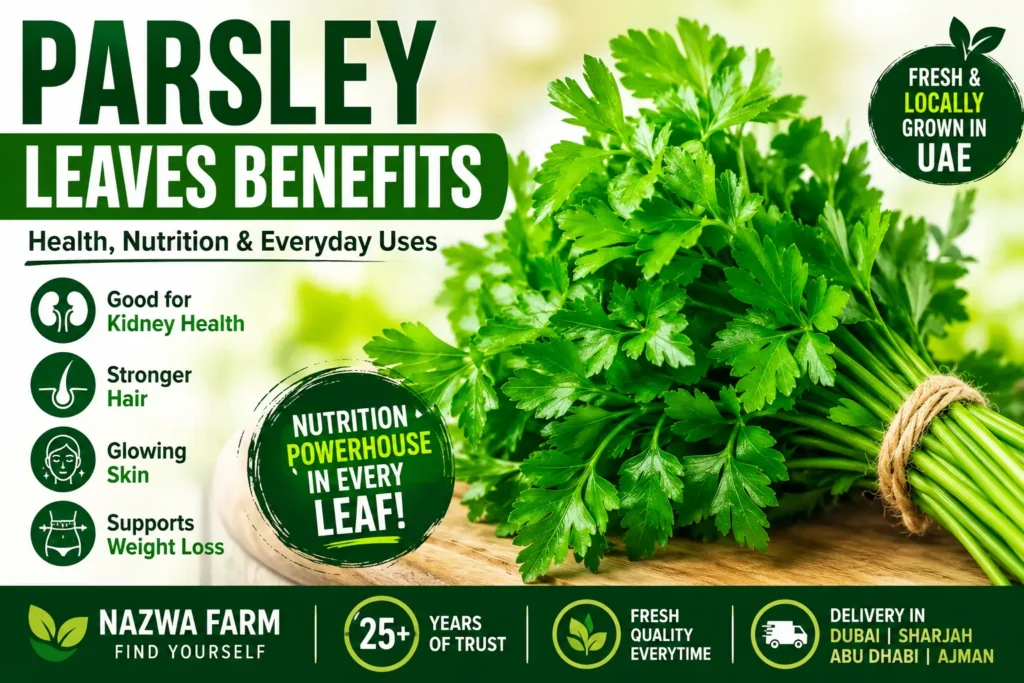
Parsley leaves are one of the most nutritionally dense herbs used in everyday cooking — they’re rich in vitamins C, K, and A, support kidney health, aid digestion, and can even contribute to healthier hair and skin. For Dubai residents, chefs, and home cooks, fresh parsley (known as baqdounis or bagdunis in Arabic) is a kitchen essential that deserves more attention than it gets as a garnish.
Whether you’re preparing tabbouleh in Al Barsha, marinating grilled meats in Deira, or stocking a hotel kitchen in Downtown Dubai, understanding what parsley actually does — nutritionally and culinarily — helps you use it better and source it smarter.
In this post, we’ll cover the full picture: what parsley leaves are and why they matter, the scientifically supported benefits for kidney function, hair, skin, and weight, how to make boiled parsley water, how to store fresh parsley properly in the UAE climate, and where to find consistently fresh supply across Dubai, Sharjah, Ajman, and Abu Dhabi.
What Is Parsley? (And What Is Bagdunis?)
| Parsley (Petroselinum crispum) is a leafy herb native to the Mediterranean, now used worldwide. In Arabic-speaking communities across the UAE, it is called bagdunis or baqdounis. It comes in two main varieties — flat leaf (preferred by chefs for cooking) and curly leaf (mainly used for garnish). Nutritionally, flat leaf parsley is considered superior for culinary and health uses. |
Parsley has been cultivated for over 2,000 years, first as a medicinal plant and later as a culinary herb. In the UAE’s diverse food culture, you’ll find it in Arabic tabbouleh, Lebanese fatoush, Iranian stews, South Asian marinades, and Continental sauces — all using the same herb under different names. If someone asks you for bagdunis, maqdounis, or flat leaf parsley, they’re referring to the same plant.
What is bagdunis in English? Bagdunis is simply the Arabic name for parsley. The word comes from the Greek ‘petroselinon’ through Arabic phonetic adaptation. So if you’re searching for ‘bagdunis Abu Dhabi‘ or ‘bagdunis Dubai’, you’re looking for fresh parsley supplies.
Parsley Leaves Nutrition Facts — What Makes It So Powerful
| Fresh parsley is exceptionally nutrient-dense. Just 30g (about one small bunch) provides over 300% of your daily Vitamin K, more than 50% of daily Vitamin C, and meaningful amounts of Vitamin A, folate, and iron — with almost no calories. It also contains the antioxidants lutein, zeaxanthin, and apigenin. |
| Nutrient | Why It Matters |
| Vitamin K | Supports bone health and blood clotting — parsley is one of the richest dietary sources |
| Vitamin C | Antioxidant, immune support, collagen production — more than many citrus fruits per gram |
| Vitamin A (Beta-carotene) | Eye health, skin cell turnover, immune function |
| Folate (B9) | Cell division, pregnancy support, heart health |
| Iron | Oxygen transport — especially valuable plant-based iron source |
| Apigenin | Flavonoid with anti-inflammatory and antioxidant properties |
| Luteolin | Supports cardiovascular function and anti-inflammatory response |
| Myricetin | May support blood sugar regulation |
| Calories (per 30g) | Approximately 11 calories — essentially a ‘free’ nutritional add-on |
For home cooks and chefs across Dubai who use parsley as a fresh garnish or ingredient, it’s worth knowing that a generous handful of this herb is providing a measurable nutritional contribution to every dish — not just aesthetic value.
Parsley Leaves Benefits for Kidney — What the Research Actually Says
| Parsley has been used in traditional medicine as a diuretic — it stimulates urine production, which may support kidney function by helping flush the urinary tract. Some animal studies suggest parsley extract may help reduce kidney stone formation by lowering urinary calcium oxalate levels. However, people with existing kidney disease should consult a doctor before increasing parsley intake significantly, as its high Vitamin K and oxalate content can be a concern. |
The connection between parsley and kidney health comes from two mechanisms: its diuretic properties (parsley stimulates the kidneys to produce more urine) and its antioxidant content, which may reduce oxidative stress in kidney tissue.
Traditional Arabic and Iranian medicine has long prescribed boiled parsley water — sometimes called parsley tea — for urinary tract support. In UAE households, this is a common home remedy, and there is some scientific plausibility to the practice:
- Increased urine output helps clear the urinary tract of bacteria and waste
- Parsley’s flavonoids, particularly apigenin, have shown anti-inflammatory properties in research
- Regular hydration support (which parsley tea encourages) is one of the best preventative measures for kidney stones
Important caveat for UAE residents: If you have chronic kidney disease (CKD), are on blood thinners, or have been advised to follow a low-potassium or low-oxalate diet, speak to your doctor before drinking parsley water regularly. The herb’s high Vitamin K content can interfere with anticoagulant medications like warfarin.
How to Make Boiled Parsley Water — Step by Step
| Boiled parsley water (parsley tea) is made by simmering fresh parsley leaves in water for 5–10 minutes, then straining and drinking warm. It is consumed in UAE households as a home remedy for digestion, bloating, and urinary tract support. |
Here’s the traditional method used across Middle Eastern households — simple, practical, and easily made with fresh parsley from your local supplier:
- Wash 30–50g of fresh parsley leaves thoroughly under cold water
- Place in a small pot with 500ml of water
- Bring to a boil, then reduce to a simmer for 5–10 minutes
- Remove from heat and allow to cool for 2 minutes
- Strain out the parsley leaves
- Drink warm, optionally with a squeeze of lemon or a small amount of honey
- Consume once or twice daily — do not exceed 3 cups per day
The resulting liquid is a mild, grassy-tasting herbal drink. In Dubai and Sharjah households, it’s sometimes drunk first thing in the morning on an empty stomach. Always use fresh parsley for this — dried parsley loses much of its active compounds during the drying process.
Parsley Leaves Benefits for Hair — Can It Really Help?
| Parsley supports hair health primarily through its high vitamin C content (needed for collagen synthesis in the scalp), iron (essential for carrying oxygen to hair follicles), and sulfur compounds. Some people apply parsley water topically as a hair rinse, claiming it reduces dandruff and adds shine. Eating parsley regularly as part of a nutritious diet supports overall hair health. |
Hair loss and poor scalp health have multiple causes — nutritional deficiency is one of them. Parsley addresses several nutritional gaps that can affect hair quality:
- Vitamin C in parsley supports collagen production. Collagen strengthens hair follicles and may reduce breakage.
- Iron is critical for healthy hair growth. Iron-deficiency anemia is a common, underdiagnosed cause of hair loss — particularly in women in the UAE. Parsley’s iron content, while not as bioavailable as meat-based iron, contributes to overall intake.
- Folate supports cell division, including the rapid cell turnover that hair follicles require for healthy growth cycles.
- Antioxidants (apigenin, luteolin) protect scalp cells from oxidative damage.
For topical use: Some UAE households make parsley rinse water (boiled and cooled) and apply it to the scalp before washing. The evidence for topical parsley benefits is largely anecdotal, but given its antifungal properties (studied in lab settings), it may help with dandruff control. Use cooled parsley tea, massage into the scalp, leave for 20 minutes, and rinse.
Parsley Leaves Benefits for Skin — Vitamin C and Bright, Healthy Skin
| Parsley is exceptionally rich in Vitamin C, which is a key ingredient in collagen synthesis — the protein that keeps skin firm, elastic, and youthful. It also contains chlorophyll, which has mild antimicrobial properties. Regular dietary consumption of parsley contributes to clearer skin through its antioxidant and anti-inflammatory activity. |
Dubai’s intense sun and dry climate make skin care a serious concern for many residents. Oxidative stress from UV exposure accelerates skin aging — and antioxidants from diet are one of the most effective defenses.
- Vitamin C in parsley directly supports collagen synthesis — consuming it regularly contributes to firmer, more elastic skin
- Beta-carotene (Vitamin A precursor) supports skin cell renewal and may help with uneven skin tone
- Chlorophyll gives parsley its vibrant green color and has mild antimicrobial properties that may benefit acne-prone skin when applied topically
- Anti-inflammatory flavonoids help reduce redness and irritation associated with skin conditions
Topical use: Fresh parsley juice or parsley-infused water can be applied to the skin as a mild toner. It’s been used in traditional beauty practices across the Arab world — particularly as a spot treatment for hyperpigmentation. However, always patch-test first, and don’t apply to broken skin.
Parsley Leaves Benefits for Weight Loss — Does It Actually Work?
| Parsley is not a weight loss herb in the direct sense — no herb burns fat. However, parsley contributes to weight management by adding significant nutrient density with almost zero calories, supporting healthy digestion, reducing water retention through its diuretic effect, and replacing higher-calorie flavor enhancers in cooking. It also contains compounds that support blood sugar regulation. |
Here’s how parsley fits practically into a weight-conscious diet common among Dubai residents:
- Zero-calorie flavor — replacing heavy sauces and high-sodium condiments with fresh parsley cuts calories without sacrificing taste
- Digestive support — parsley’s volatile oils stimulate digestive enzymes and may reduce bloating
- Diuretic effect — reduces water retention, which can contribute to a lighter feeling and reduced puffiness
- Blood sugar — animal studies suggest parsley’s flavonoids may support blood glucose regulation, which indirectly supports weight management
- Satiety — the fiber content of fresh parsley is modest but contributes to overall dietary fiber intake
Parsley vs Coriander — What’s the Actual Difference?
| Parsley (baqdounis) and coriander (kusbara) look similar but taste completely different. Parsley has a mild, clean, slightly peppery flavor that blends into dishes without dominating. Coriander has a bold, citrusy, distinctive flavor that either delights or divides — it’s one of the most polarizing herbs globally. For most Arabic and Mediterranean recipes, parsley is the correct choice; South Asian and Middle Eastern dishes often specify coriander. |
| Comparison Point | Parsley / Coriander |
| Flavor Profile | Mild, clean, slightly grassy · Parsley / Coriander: Bold citrusy, distinctive, polarizing |
| Arabic Name | Baqdounis / Bagdunis · Kusbara / Kuzbarah |
| Hindi/Urdu Name | Ajmood · Hara Dhaniya / Dhaniya Patta |
| Main Cuisine Use | Arabic, Mediterranean, Continental · South Asian, Middle Eastern, Latin, Southeast Asian |
| Best Raw Use | Tabbouleh, salads, garnish · Chutneys, fresh salsas, garnish |
| Best Cooked Use | Soups, sauces, pasta · Curries, rice dishes, grilled meats |
| Look | Flat or curly, lighter green · Softer, rounder, darker green leaves |
| Grown in UAE? | Yes — Nazwa Farm supplies UAE-grown parsley · Yes — Nazwa Farm supplies UAE-grown coriander |
Is Parsley Grown in the UAE?
| Yes. Parsley is grown commercially in the UAE, including at Nazwa Farm in Nazwa, Sharjah. UAE-grown parsley is available for wholesale and retail supply across Dubai, Sharjah, Ajman, and Abu Dhabi. Locally grown supply has a shorter supply chain, which means fresher herbs with better aroma and shelf life than imported alternatives. |
Many Dubai residents assume all fresh herbs come from overseas imports — Egypt, Iran, or Europe. In reality, the UAE has a growing local agriculture sector that supplies parsley, coriander, mint, dill, and other leafy vegetables to the local market.
At Nazwa Farm, we’ve been growing herbs in Sharjah’s soil for over 25 years. Local production means parsley travels a fraction of the distance that imported herbs do — and that matters enormously for freshness, aroma, and shelf life. A bunch of parsley from our farm reaches a Dubai kitchen the same day or next morning. Imported parsley may be four to seven days post-harvest by the time it reaches a UAE shelf.
How Long Does Fresh Parsley Last in the UAE — and How to Store It
| Fresh parsley lasts 5–10 days when stored correctly. In the UAE’s warm, humid climate, improper storage can shorten this to 1–2 days. The best method is to treat parsley like flowers: trim the stems, place upright in a small amount of water in a glass, cover the leaves loosely with a bag, and refrigerate. Change the water every two days. |
The UAE climate is challenging for storing fresh herbs — high ambient temperatures, dry air-conditioned interiors, and warm humidity outside all accelerate wilting and microbial growth. Here’s what actually works:
Best Methods to Store Fresh Parsley in Dubai / UAE
- Vase method (recommended): Trim 1cm from the stems. Stand parsley upright in a glass with 3–4cm of cold water. Cover leaves loosely with a plastic bag. Refrigerate — lasts 7–10 days.
- Paper towel method: Gently dry the parsley. Wrap loosely in a slightly damp paper towel. Place in a sealed container or zip bag in the crisper drawer. Lasts 5–7 days.
- Freezing: Blanch briefly (30 seconds), pat dry, freeze flat on a tray, then transfer to a bag. Loses texture but retains flavor — ideal for cooked dishes.
- What NOT to do: Don’t wash before storing unless you dry it completely first. Don’t store near ethylene-producing fruits (apples, bananas). Don’t leave at room temperature — in Dubai’s heat, parsley wilts within hours.
Pro tip for commercial kitchens in Dubai: Rotate parsley stock FIFO (first in, first out). If you’re receiving daily or twice-weekly deliveries, prioritize using older stock first thing in morning prep. Fresh-delivered parsley should go to the back of the cold storage.
Fresh Parsley Supply Across Dubai, Sharjah, Ajman, and Abu Dhabi
| Nazwa Farm supplies fresh parsley to businesses and households across all four main UAE emirates — Dubai, Sharjah, Ajman, and Abu Dhabi — farm-direct from Nazwa, Sharjah. Wholesale and retail quantities are available. |
Whether you run a Pakistani restaurant in Al Qusais, a juice bar in Al Majaz, a Mediterranean restaurant in Business Bay, or a hotel kitchen in Abu Dhabi’s Corniche area, consistent parsley supply from a single, reliable source simplifies operations considerably.
Many Dubai-based food businesses split their herb sourcing between multiple vendors — one for coriander, one for parsley, another for mint and dill. Consolidating through a single farm supplier with access to 20+ herb varieties, like Nazwa Farm, reduces procurement complexity, improves consistency, and often delivers better pricing for regular orders.
| Emirates | Key Delivery Areas |
| Dubai | Deira · Bur Dubai · Al Quoz · Al Qusais · International City · Business Bay · JLT · Al Barsha · Al Rashidiya · Jebel Ali |
| Sharjah | Al Majaz · Al Nahda · Muwaileh · Al Taawun · Industrial Area · Al Jubail Market · Al Khan · Rolla |
| Ajman | Al Nuaimiya · Al Rashidiya · Al Jurf · Industrial Area · Al Rawda · Al Hamidiya |
| Abu Dhabi | Mussafah · Khalifa City · MBZ City · Al Mina Market · Al Khalidiyah · Tourist Club Area |
Why Dubai Businesses Choose Nazwa Farm for Fresh Parsley
| Nazwa Farm has 25+ years of agricultural experience in the UAE. We supply fresh parsley and 19 other leafy vegetables direct from our Sharjah farm to Dubai, Ajman, Sharjah, and Abu Dhabi. For restaurants, hotels, supermarkets, and caterers, we offer dependable wholesale supply with transparent pricing (AED 15–25 per 60-bundle box) and direct farm communication. |
Over 25 years, we’ve seen what genuinely matters to UAE food businesses: it’s not just the price of the parsley. It’s whether it arrives on time. Whether it looks presentable for a hotel buffet. Whether the stems hold up through a full service. Whether you can speak directly to the supplier when there’s an issue — not a broker three steps removed.
Our philosophy — Find Yourself — reflects something deeper than farming. We believe that connection to genuinely fresh, naturally grown produce brings people back to real flavor, real nutrition, and real quality. That’s what we’ve tried to do for 25 years in the UAE: grow herbs that make a difference on the plate.
- 25+ years of UAE farming experience — we understand the climate, seasonality, and quality expectations
- Direct farm supply — no unnecessary brokers or cold-chain intermediaries
- 20 herb varieties — parsley, coriander, mint, dill, zaatar, methi, palak, moulokhia, pak choy, and more
- Transparent pricing — AED 15–25 per box of 60 bundles, with custom quotes for bulk
- Honest communication — WhatsApp or call directly and you speak to the farm team
| Need Fresh Parsley Delivered to Your Dubai Business? Farm-direct · Sharjah, Dubai, Ajman & Abu Dhabi · AED 15–25/box · 60 bundles 📞 +971 550 936 9091 | admin@nazwafarm.com | nazwafarm.com |
| ❓ Frequently Asked Questions — Parsley Leaves Benefits |
Q: What are the main benefits of eating fresh parsley leaves?
Fresh parsley is rich in Vitamins C, K, and A, plus iron, folate, and antioxidant flavonoids. Benefits include supporting kidney function, promoting healthy skin and hair, aiding digestion, reducing inflammation, and contributing to bone health — all with almost no calories.
Q: Is parsley good for the kidneys?
Parsley has diuretic properties that may support kidney and urinary tract health by increasing urine flow. Some research suggests it may help prevent kidney stones. However, those with kidney disease or on blood thinners should consult a doctor before consuming large quantities.
Q: What is bagdunis in English?
Bagdunis (also spelled baqdounis) is the Arabic name for parsley. It refers to the same herb — Petroselinum crispum — used globally in cooking.
Q: How do you store fresh parsley in the UAE so it lasts longer?
Trim the stems and stand parsley upright in a glass with a small amount of water, like flowers. Cover loosely with a bag and refrigerate. In Dubai’s climate, this method keeps parsley fresh for 7–10 days. Never store at room temperature — parsley wilts within hours in UAE heat.
Q: What is the difference between parsley and coriander?
Parsley (baqdounis) has a mild, clean flavor used in Arabic and Mediterranean cooking. Coriander (kusbara) has a bold citrusy taste used in South Asian, Middle Eastern, and Latin cuisines. They look similar but taste completely different — substituting one for the other changes the dish significantly.
Q: Is parsley grown in the UAE?
Yes. Parsley is grown commercially in the UAE by farms including Nazwa Farm in Nazwa, Sharjah. Locally grown parsley is available wholesale for Dubai restaurants, hotels, and retailers — and has better freshness than imported alternatives.
Q: Where can I buy fresh parsley wholesale in Dubai?
Nazwa Farm supplies fresh parsley wholesale to restaurants, supermarkets, caterers, and food businesses across Dubai, Sharjah, Ajman, and Abu Dhabi. Call or WhatsApp +971 550 936 9091 or email admin@nazwafarm.com for pricing and availability.
Final Thoughts — Parsley Is More Than Just a Garnish
If there’s one thing this guide makes clear, it’s that parsley deserves a proper place in the UAE kitchen — not as an afterthought on the side of a plate, but as an intentional, nutritious, flavorful ingredient.
Its benefits for kidney health, hair, skin, and weight management are supported by nutritional science — not just tradition. Its culinary versatility across Arabic, Mediterranean, South Asian, and international cuisines makes it one of the most useful herbs in any commercial or home kitchen. And with locally grown supply available farm-direct across Dubai, Sharjah, Ajman, and Abu Dhabi, there’s no reason to rely on older imported stock.
At Nazwa Farm, we’ve spent 25 years growing herbs that find their way into family kitchens, hotel buffets, restaurant prep stations, and supermarket shelves across the UAE. Find Yourself with produce that’s genuinely fresh — and notice the difference it makes.
Ready to source fresh parsley for your business? Visit: