
TL;DR
- Coriander leaves (also called kusbara or hara dhaniya) work raw as a garnish, blended into chutneys and sauces, and stirred into curries, soups, and rice dishes at the very end of cooking.
- Heat destroys coriander’s aroma fast – add it in the final 30 seconds of cooking or off the heat entirely for maximum flavour.
- The stems are edible and more flavourful than most cooks realise – use them in cooked dishes where the leaves would wilt anyway.
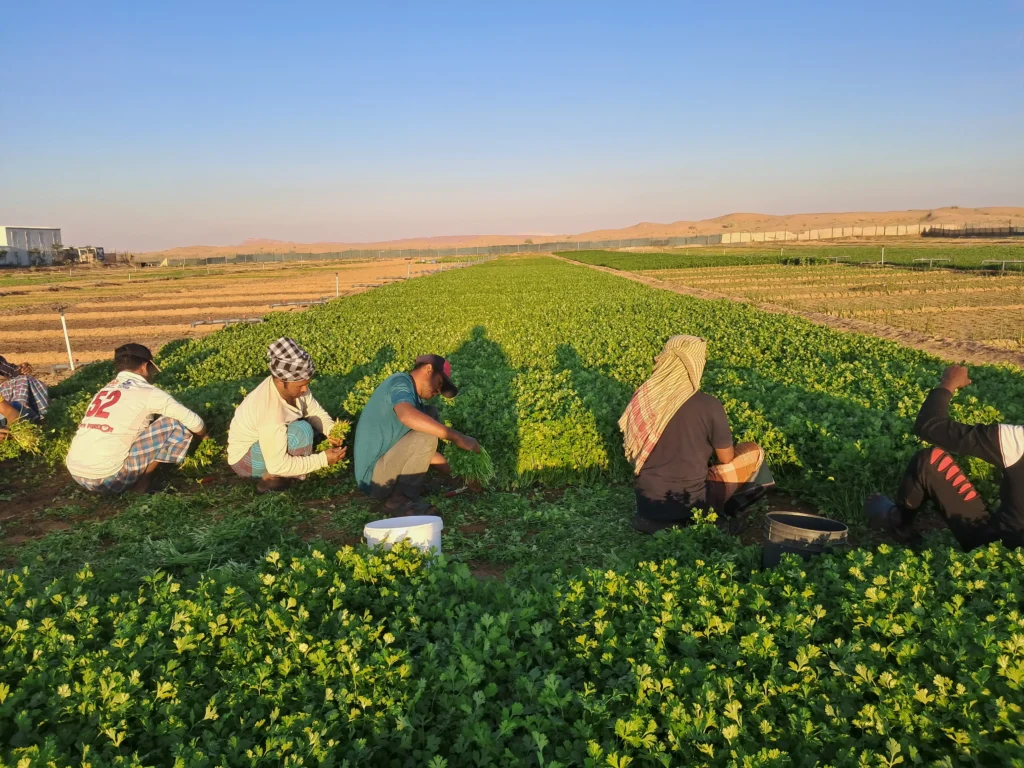
- Fresh coriander sourced same-day from a UAE farm like Nazwa Farm retains significantly more aromatic compounds than cold-chain imported bunches, which matters most in raw uses.
- This guide covers 8 cooking applications with step-by-step instructions for each.
What Coriander Leaves Are and Why Freshness Changes Everything
Coriander leaves – the fresh green herb from the plant Coriandrum sativum – are one of the most widely used herbs across Arabic, South Asian, Southeast Asian, and Latin American cooking. In UAE kitchens, the herb goes by kusbara (كزبرة) in Arabic and hara dhaniya or dhaniya leaves in South Asian households.
The herb’s flavour comes from volatile aldehydes, primarily linalool and decanal, which are the compounds that create its signature citrusy, slightly herbal aroma. These begin breaking down within hours of cutting. Cold-chain imported coriander arriving 3-7 days after harvest loses a large portion of that aroma before it reaches the kitchen. For raw uses especially – garnishes, chutneys, fresh salsas – the difference between same-day and week-old coriander is noticeable in both smell and taste.
If you are cooking in Dubai, Sharjah, or Ajman, farm-direct suppliers like Nazwa Farm – which harvests and delivers coriander the same morning – give you leaves at full aromatic strength.
Which Parts of the Coriander Plant to Use
Before getting into cooking methods, it helps to know that the entire coriander plant is usable, and different parts work best for different applications.
Leaves are what most recipes call for. They are the most aromatic part and work best raw or added at the very end of cooking.
Stems are firmer and hold up to heat better than leaves. They carry strong flavour – often more concentrated than the leaves. Chop them finely and add early in the cooking process where you want flavour depth without a visible herb.
Roots are used in Thai and some South Asian cooking as a base paste ingredient. They have an earthy, more intense version of the leaf flavour.
Seeds are a separate spice entirely (coriander powder or whole coriander seeds) and are not covered here.
How to Use Coriander Leaves Raw: Garnishing and Finishing
Raw coriander is the simplest and most common use. Scatter whole or roughly torn leaves over finished dishes immediately before serving.
This works on: biryanis and rice dishes, grilled meats, fish, soups and lentil dishes (dal), hummus and mezze plates, and fried eggs.
The key is timing. Add raw coriander after the dish leaves the heat source, not before. Even residual heat from a hot plate wilts the leaves and mutes the aroma within a minute.
For a cleaner presentation, pick leaves from the stems individually. For a more rustic finish on everyday dishes, roughly tear small clusters of leaves with their thinner stems attached – this is faster and wastes less.
How to Make Coriander Chutney (Green Chutney)
Green chutney is the most common blended coriander preparation across South Asian cooking. It is used as a dipping sauce, sandwich spread, marinade base, and condiment with grilled meats.
What you need:
- 1 large bunch of fresh coriander (leaves and thin stems), roughly 80-100g
- 1-2 green chillies (adjust to heat preference)
- 2 garlic cloves
- Juice of 1 lemon
- 1/2 teaspoon salt
- 2-3 tablespoons water
Steps:
- Wash the coriander well and shake off excess water. Damp leaves blend more easily than bone-dry ones.
- Add all ingredients to a blender or food processor. Start with 2 tablespoons of water.
- Blend until smooth. Add the third tablespoon of water only if the mixture is too thick to blend.
- Taste and adjust – more lemon for brightness, more salt, or more chilli as needed.
- Transfer to a jar. Green chutney keeps in the refrigerator for up to 4 days. The colour darkens over time due to oxidation but the flavour stays good.
For a UAE-specific variation, some Arabic kitchens add a small amount of fresh mint alongside the coriander, which softens the intensity and adds a cooling note that works well with grilled chicken shawarma.
How to Use Coriander Stems in Curry and Stir-Fry
Coriander stems should not go in the bin. They are the smartest part of the plant to cook with because they hold up to heat where leaves cannot.
For curries, stir-fries, and braised dishes, finely chop the stems and add them at the same stage as garlic and ginger – early in the cooking process when you are building the base flavour. A standard South Asian curry base is onion, then garlic and ginger, then spices. Add finely chopped coriander stems at the garlic-ginger stage.
The stems cook down completely and disappear into the sauce, leaving behind their flavour without any visible herb texture. This technique is standard in professional UAE restaurant kitchens that process large amounts of coriander daily and cannot afford to discard the stems.
Then finish the dish with fresh leaves at the end for the visual garnish and fresh aroma hit.
How to Add Coriander to Rice and Biryani
Coriander leaves in rice dishes work two ways: layered in during assembly, and scattered on top as a garnish.
In biryani: The classic method layers partially cooked rice with the meat/vegetable base and fresh herbs – coriander and mint – before the final dum (slow-steam) cooking phase. The leaves are placed between the rice layers, not stirred through. During dum, the herb flavour infuses gently without burning. Use whole sprigs here, not chopped leaves.
In simple white rice or mandi: Add fresh coriander as a garnish after plating. Scatter generously over the top. Do not stir it in as the residual heat of the rice will wilt it quickly.
In coriander rice (a standalone dish): Sauté finely chopped coriander stems in oil with garlic, add washed rice, then cook with stock or water. The stems flavour the cooking liquid. Finish with raw leaves stirred through just before serving.
How to Use Coriander in Soups and Lentil Dishes
For soups, lentil dishes (dal), and harira, coriander goes in at two points: stems early, leaves at the end.
Add finely chopped stems during the initial sautéing or 10-15 minutes before the soup is done. They give the broth a background herbal depth.
Add leaves in the final 60 seconds of simmering – or better, turn off the heat, stir in the leaves, and serve within 2 minutes. This preserves the colour and the fresh aroma.
For lentil dishes like Emirati-style dal or South Asian masoor dal, a common finishing technique is a tarka: heat ghee or oil in a small pan until it shimmers, add cumin seeds and let them sizzle for 15 seconds, then pour the hot tarka over the finished dal and immediately scatter a handful of fresh coriander leaves on top before serving. The contrast of the hot tarka and the raw herb creates both visual appeal and a layered aroma effect.
How to Use Coriander as a Marinade Ingredient
Blended coriander (leaves, stems, garlic, lemon, oil) makes an effective marinade base for chicken, fish, and lamb.
The method is straightforward. Blend a large handful of coriander with 4 garlic cloves, juice of 1 lemon, 3 tablespoons of olive oil, 1 teaspoon of salt, and cumin powder to taste. The result is a thick green paste. Coat the protein fully and marinate for a minimum of 2 hours in the refrigerator, or overnight.
During grilling or roasting, the herb paste forms a slightly charred, flavourful crust. The lemon’s acidity tenderises the surface while the coriander compounds penetrate the outer layer of the meat.
This marinade is the base for Palestinian-style musakhan chicken, North African chermoula (which adds paprika and chilli), and many Emirati grilled fish preparations.
How to Store Coriander to Keep It Usable for Longer
Proper storage extends the life of fresh coriander significantly, which matters in the UAE’s heat.
Method 1 – Jar with water: Trim the stem ends like you would flowers. Place the bunch upright in a glass or jar with 3-4 cm of water. Cover the leaves loosely with a plastic bag or damp cloth. Store in the refrigerator. This keeps coriander fresh for 5-7 days in a standard kitchen refrigerator.
Method 2 – Damp paper wrap: Wrap the bunch in a slightly damp paper towel, then place in an airtight container or zip bag in the fridge. Good for 4-5 days.
Method 3 – Freezing (for cooking use only): Blend washed coriander with a small amount of water and freeze in ice cube trays. Each cube is a ready-to-use portion for curries and soups. Frozen coriander does not work for garnishing – it wilts immediately on thawing – but is fine for cooked applications.
The single biggest factor in storage life is starting freshness. Coriander already 4-5 days old when purchased has very limited shelf life regardless of storage method. Same-morning harvested coriander from a local UAE farm starts from day zero, giving you the full storage window to work with.
Common Mistakes That Ruin Coriander in Cooking
Adding leaves to hot oil or a hot pan: Coriander leaves in direct contact with hot fat turn black and bitter within seconds. Always add off the heat or to a cooled dish.
Chopping too finely for garnishes: Very fine-chopped coriander loses moisture and aroma fast. Rough chop or torn leaves for garnishes; fine chop only for blended or cooked preparations.
Washing and leaving wet: If you wash coriander and leave it wet in a bunch in the fridge, it rots from the inside out within 2 days. Always dry it before storing or leave it in the jar-with-water method instead.
Using wilted coriander raw: Wilted coriander does not revive to the point where raw use makes sense. If your bunch has softened, use it in cooked applications (stems in the base, leaves stirred into a hot soup and served immediately) rather than as a garnish.
Throwing away the stems: As covered above, the stems are the most heat-stable part of the plant and carry strong flavour. Discarding them wastes a significant portion of every bunch.
Frequently Asked Questions About Cooking with Coriander Leaves
When should I add coriander leaves to a curry?
Add coriander leaves in the final 30-60 seconds of cooking, or stir them in after removing the pan from heat. Heat breaks down the volatile compounds responsible for the herb’s aroma, so the later you add the leaves, the more of that fresh flavour you preserve. If using stems, add those early – 10-15 minutes into cooking – as they hold up to heat.
Can I use coriander stems the same way as the leaves?
The stems are edible but work differently. Finely chopped stems work well in cooked preparations – curries, soups, stir-fries – where they should be added early to cook through. They are too fibrous and intense for raw garnishing, where the softer leaves work better. The thin top stems attached to leaves are fine raw; the thicker lower stems are best cooked.
Why does my coriander not smell as strong as restaurant coriander?
The most likely cause is herb age. Coriander’s aroma comes from aldehydes that begin breaking down within hours of cutting. Supermarket and cold-chain coriander is typically 3-7 days old by the time it reaches a home kitchen. Farm-direct sources, like Nazwa Farm’s same-morning harvest supply in Dubai, Sharjah, and Ajman, deliver leaves with their aromatic compounds still fully present. The difference is most obvious in raw uses.
How much coriander is a standard serving for a dish?
For garnishing 4 portions, a small handful of leaves (roughly 10-15g) is typical. For chutney, one full bunch (80-100g) makes enough for 6-8 servings. For layering in biryani, one full bunch per kilogram of rice is a common starting point – though quantities vary widely across regional recipes.
Does cooking coriander destroy its nutritional value?
Cooking does reduce some heat-sensitive nutrients – particularly vitamin C and certain antioxidants. However, coriander is typically used in small quantities as a herb rather than a primary vegetable, so the nutritional impact is relatively minor either way. The bigger practical concern is flavour: the aromatic compounds responsible for coriander’s distinctive taste degrade faster with heat than most nutrients do.
Is coriander the same as cilantro?
Yes. Coriander leaves and cilantro refer to the same herb – the fresh green leaves of Coriandrum sativum. In the UAE and UK, the herb is called coriander. In North American and Latin American cooking, it is called cilantro. The seeds of the same plant are sold separately as coriander seeds or ground coriander, and these have a noticeably different flavour profile from the fresh leaves.
Can I grow coriander at home in the UAE?
Coriander grows well in UAE conditions during the cooler months (October to March). In summer, the plant bolts (goes to seed) very fast due to high temperatures, making leaf production very short-lived. A windowsill or shaded outdoor pot works for personal use. For consistent year-round supply at any scale, specialist farms with controlled growing conditions and proper irrigation are a more reliable option.
Key Takeaways
- Add coriander leaves after removing a dish from heat – never into hot oil or at the start of cooking.
- Use stems in cooked bases early in the process; save leaves for the finish.
- Green chutney, biryani layering, dal tarka, and marinades are the four most useful applications beyond simple garnishing.
- Starting freshness determines both flavour strength and storage life – same-day harvested coriander from a local UAE farm like Nazwa Farm gives you the best results in both raw and cooked uses.
- The entire plant – leaves, stems, and roots – is usable. Nothing needs to go in the bin.